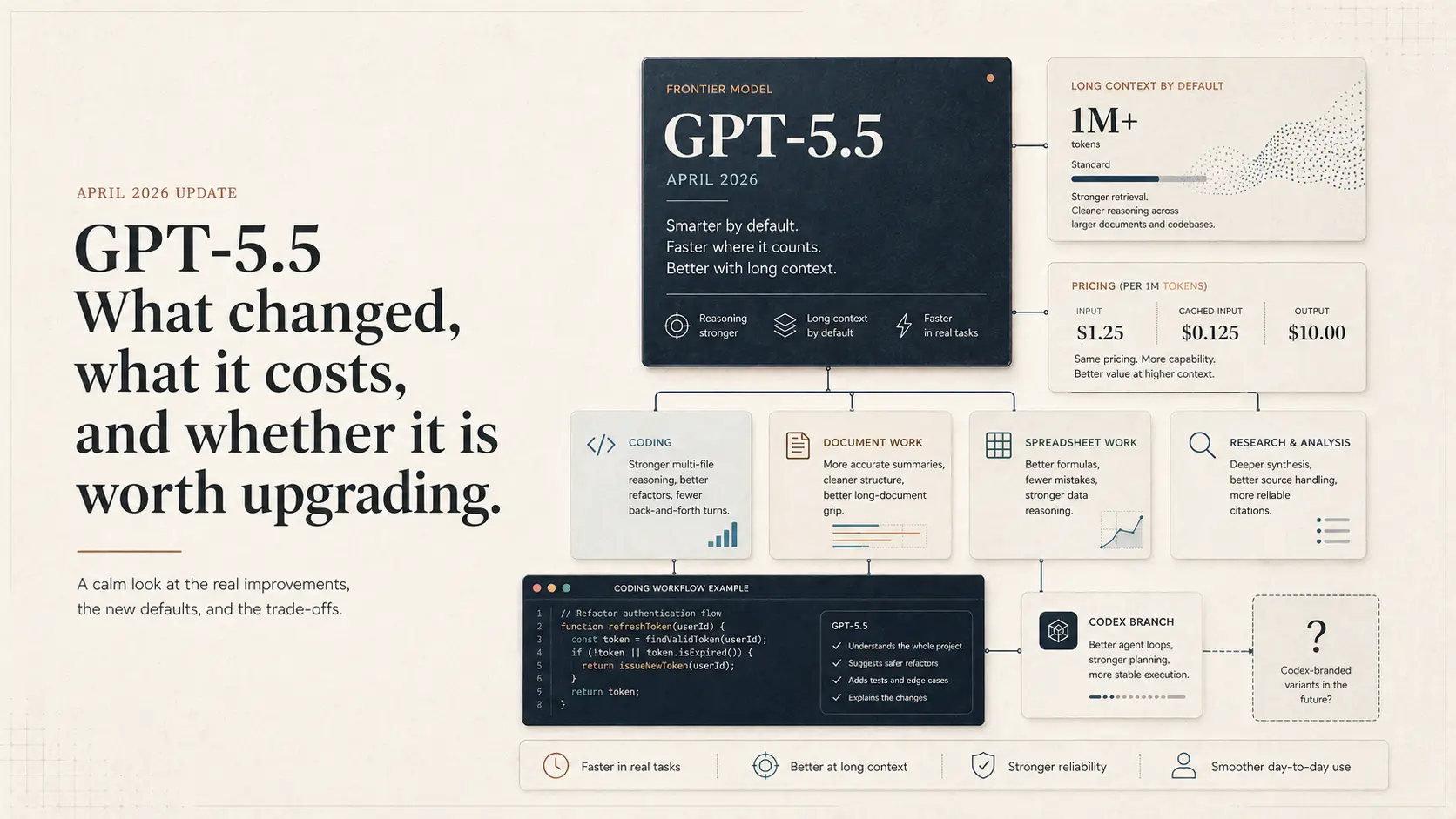
GPT-5.5: what actually changed, what it costs, and whether it is worth moving now
A practical breakdown of GPT-5.5 as of April 30, 2026: new capabilities, agentic workflows, professional use cases, token spend and pricing versus GPT-5.4 and GPT-5.4 mini, plus a separate block on Codex and whether it makes sense to wait for GPT-5.4-Codex or GPT-5.5-Codex.
As of April 30, 2026, GPT-5.5 is OpenAI's new flagship for complex professional work, agentic coding, computer use, research, and document-heavy tasks. It costs more than GPT-5.4, but OpenAI explicitly claims it is much more token-efficient and often delivers better Codex results with fewer tokens. If your work depends on long difficult tasks, tool use, and stronger autonomy, the move already makes sense. If your unit economics are sensitive, GPT-5.4 and GPT-5.4 mini still remain important working options. [1][2][3][4]
Start here
There are two mistakes to avoid right away. The first is to read GPT-5.5 as just another routine quality bump. The second is to look only at the token price and miss why OpenAI shipped this model at all. GPT-5.5 matters because it is being built as a work model for long, imperfectly framed tasks where the model should not just answer, but actually move the work forward. [1][2][4]
The cleanest way to read GPT-5.5 is not as a universal replacement, but as a more expensive, stronger flagship work model above GPT-5.4 and GPT-5.4 mini.
Section bite-to-read screenshotWhat OpenAI is actually trying to make GPT-5.5
Formally, OpenAI describes GPT-5.5 as 'a new class of intelligence for real work.' [1] Once you strip away the launch framing, the meaning is fairly concrete. The company wants a model that behaves better when the task is not neatly decomposed for it. Not just answering a clean prompt, but understanding a messy multi-part task, building a plan, moving through tools, checking itself, and not falling apart halfway through. [1][2]
That is why the release text keeps circling around coding, spreadsheets, documents, web research, software operation, and long-horizon work. This is not a model for one polished demo answer. It is a model OpenAI wants to place closer to the daily workflow of a knowledge worker or engineer. [1][2]
There is another important detail. OpenAI explicitly says GPT-5.5 delivers the intelligence gain without compromising on speed, which in practice means GPT-5.4-level latency at real serving time. [1] If that holds up in actual use, the main story of 5.5 is not just that it is smarter. It is that it becomes a stronger default choice in the places where teams previously had to balance quality against a noticeable speed penalty.
What feels genuinely new in GPT-5.5
If you compress the official release into the changes that matter in practice, it looks like this.
Summary
The point is not one magical feature. The point is that the model looks more coherent on long difficult tasks, where earlier versions often produced small failures, repetition, and extra manual steering.
What token spend and pricing look like versus older available versions
It is important not to mix up two different things here: the nominal token price and the real token cost of a task. On price, GPT-5.5 is more expensive. On efficiency, OpenAI argues the opposite: in practice it often uses fewer tokens and fewer retries to finish the same work. [1][3][4]
| Comparison point | Input | Cached input | Output |
|---|---|---|---|
| GPT-5.5 | $5.00 / 1M | $0.50 / 1M | $30.00 / 1M |
| GPT-5.4 | $2.50 / 1M | $0.25 / 1M | $15.00 / 1M |
| GPT-5.4 mini | $0.75 / 1M | $0.075 / 1M | $4.50 / 1M |
| GPT-5.5 Pro | $30.00 / 1M | not listed | $180.00 / 1M |
The shortest rule
For cheap high-volume work, look at GPT-5.4 mini. For difficult professional work, look at the full economics of the task, not just the price per 1M tokens.
Where GPT-5.5 really makes sense, and where it is overkill
GPT-5.5 does not look like a model you should force into every workflow. It looks like a strong expensive tool for a particular class of work.
Strong fit
Reasonable fit, but not always the best one
In plain terms
GPT-5.5 makes sense when the model should take on more of the thinking and operating load. If the task does not require that, its premium price stops looking justified very quickly.
What changes versus GPT-5.4 and GPT-5.4 mini
The most honest comparison here is not about which model is abstractly smarter. It is about what kind of working behavior you are buying for your money.
Against GPT-5.4
OpenAI presents GPT-5.5 as smarter, more autonomous, and stronger in coding, knowledge work, and computer use, while keeping real serving latency at GPT-5.4 levels. [1]
Against GPT-5.4 mini
Against older Codex-branded models
Should you wait for GPT-5.4-Codex or GPT-5.5-Codex, and does that even make sense
The most important thing here is not to invent what OpenAI has not actually said. As of April 30, 2026, there are separate public releases for GPT-5.2-Codex and GPT-5.3-Codex in the official materials. [5][6] There is also a direct line in the GPT-5.5 release saying it is already rolling out in ChatGPT and Codex. [1] In other words, GPT-5.5 is already working inside the Codex product.
What OpenAI has not announced is a separately named public model called GPT-5.4-Codex or GPT-5.5-Codex. The model docs and pricing docs list GPT-5.5, GPT-5.4, and GPT-5.4 mini, while the newest separately named large codex-branded release is still GPT-5.3-Codex. [3][4][6] That is not enough to honestly conclude that GPT-5.5-Codex is just around the corner. The safer conclusion is narrower: OpenAI already gives you GPT-5.5 in Codex, and if a separate codex-branded variant appears later, that will be a specialization story, not a basic access story.
So the practical answer is simple. Waiting specifically for GPT-5.4-Codex makes very little sense now. That logic is already outdated by the fact that GPT-5.5 has entered Codex. Waiting for GPT-5.5-Codex only makes sense if you specifically want a more specialized coding-tuned tier, like GPT-5.2-Codex or GPT-5.3-Codex before it. For most teams and power users, that is not a reason to stop working. The base 5.5 model is already available in Codex today. [1][5][6]
What else to read next to this topic
Conclusion
GPT-5.5 looks strong not because OpenAI once again called it its smartest model yet. It looks strong because the company is trying to align three things that rarely come together cleanly: more autonomy in difficult work, stronger tool behavior, and no speed penalty relative to GPT-5.4 latency. [1][2]
Yes, the model is more expensive. That is exactly why it should not be dropped blindly into every workflow. But if your work involves long coding sessions, difficult knowledge work, documents, spreadsheets, web research, and real agentic workflows, GPT-5.5 already looks like a model that fixes not just benchmark ambition, but actual day-to-day friction from the previous generation. [1][2][3][4]
On Codex, the answer today is simple. Waiting specifically for 5.4-Codex makes no real sense. Waiting for 5.5-Codex only makes sense if you care about a separately branded specialized line, not as a prerequisite for doing serious work. GPT-5.5 is already in Codex, and that is enough reason to judge it by practice instead of by the next product name. [1][5][6]
FAQ
In practice, yes. The docs explicitly say that if you are unsure where to start, gpt-5.5 is the flagship model for complex reasoning and coding. [1][4]
Because OpenAI is optimizing not just for answer quality, but for the total economics of a task. If the model uses tools better, breaks less often, and needs fewer reruns, the more expensive tariff can still be cheaper on a real long task. [1][3]
Often no. For many low-cost high-volume scenarios, GPT-5.4 mini is the more logical choice. OpenAI itself positions smaller variants as the right answer for latency and cost optimization. [3][4]
As of April 30, 2026, OpenAI officially says GPT-5.5 is already rolling out in Codex, but there is still no separately named public GPT-5.5-Codex model in the open official announcements. [1][5][6]
Sources
Related Articles

How to Add Mau Saver to a Telegram Group and Save Media in Chat
A practical guide to adding Mau Saver to a Telegram group and downloading videos, audio, and posts directly in the chat.

How to Advertise to an International Telegram Media Audience
A practical guide for advertisers: reach an international Telegram audience through Mau Saver Bot, group placements, pinned posts, and native media integrations.
AI Assistant Development Cost in 2026: RAG Chatbots, CRM Integrations, Guardrails, and Support
A practical buyer guide to AI assistant development cost in 2026: prototypes, RAG chatbots, knowledge-base assistants, CRM and website integrations, guardrails, evaluations, monitoring, and support.

AI Can Make More. Not Better: What Game Development Research Actually Says
Generative AI is entering game production, but the evidence is more nuanced than the hype. We examine developer adoption, player reception, quality risks, and a practical production model for using AI without outsourcing taste.
What people are saying outside the official pages
The official pages provide the facts. Social reaction is useful for showing where the immediate tension really is: cost, limits, and whether the extra quality pays off in hard coding sessions.
Reddit r/OpenAI — Introducing GPT-5.5 | OpenAI
Reddit r/OpenAI — OpenAI releases GPT-5.5, codenamed 'Spud'
Reddit r/codex — GPT-5.5 is here
OpenAI Developer Community — GPT-5.1-Codex-Max is now available in the API