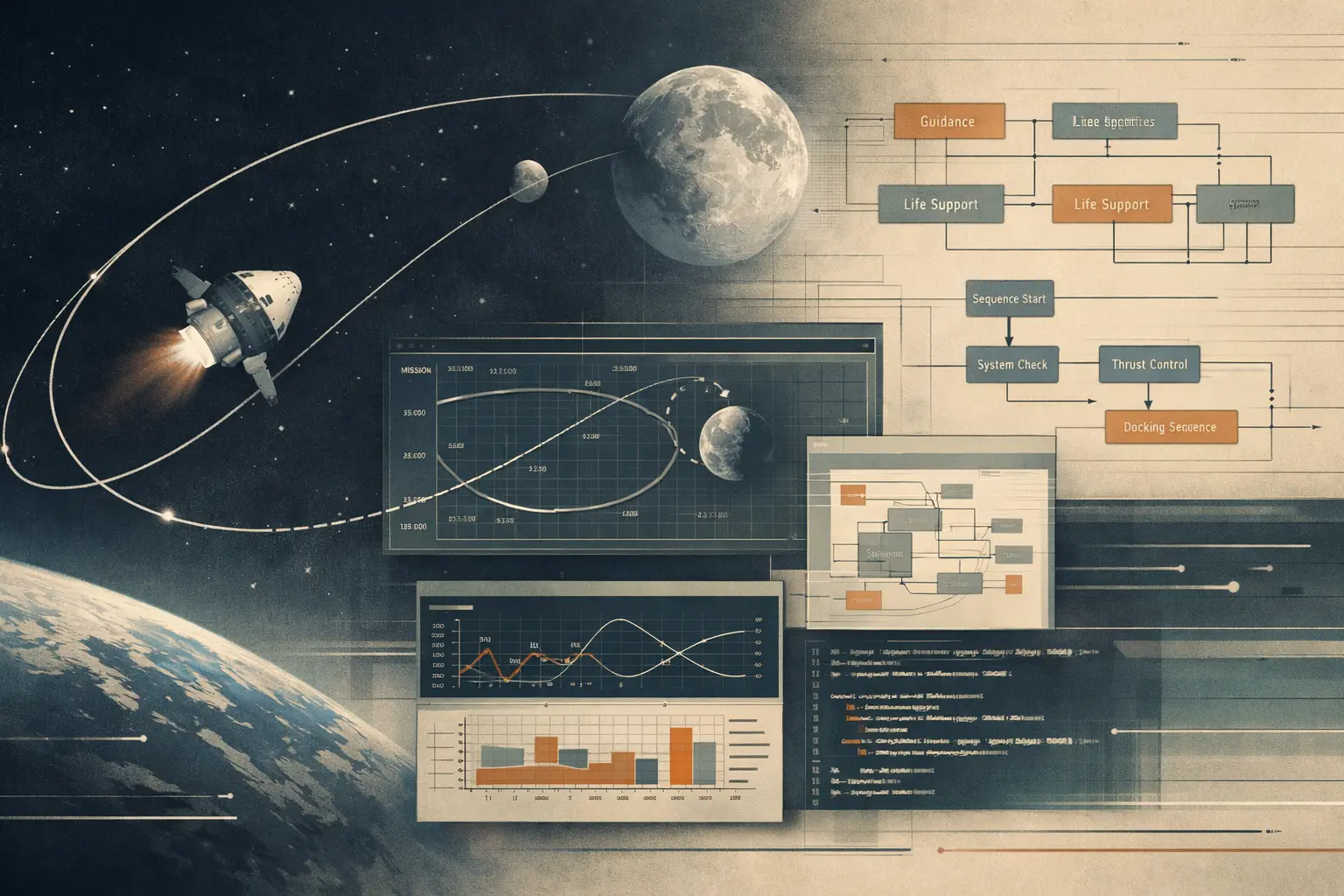
Artemis II and the Code That Carries Humans to the Moon
This article unpacks NASA's Artemis II mission, launched on April 1, 2026, and explains what it really says about modern engineering: flight software, backup logic, simulation, telemetry, human control, and the careful role AI can play in space systems.
NASA did launch Artemis II on April 1, 2026, and the mission matters to IT not because space is romantic, but because it shows what software engineering looks like inside a crewed system. Public Artemis II material points to a layered stack: SLS flight software, Orion backup software, simulation, mission control, MER, communications networks, and telemetry loops. AI already has a place here, but as an engineering support layer, not as a replacement for verification or human authority. [1][4][5][6][7][8][10][12]
What matters most about Artemis II, and why IT people should care
The most interesting part of this story is not simply that NASA is heading back around the Moon. It is the kind of software stack that stands behind a mission where you cannot ship the humans in a later patch.
What you need to know about Artemis II before the software angle
As of April 5, 2026, Artemis II is already in flight after launching on April 1 at 6:35 p.m. EDT from Kennedy Space Center. For the broader public, it is the first crewed journey around the Moon since Apollo. For NASA, it matters even more because Artemis II tests how SLS, Orion, ground systems, and crew interfaces behave in the real deep-space environment, not just in briefing slides. [1][2][3][4]
AP described the mission accurately as the first human trip toward the Moon in more than half a century. But from an engineering perspective, Artemis II is mainly about system confidence, not symbolism. [3]
That is why the important story is not only the rocket, the capsule, or the crew. It is how NASA gathers telemetry, keeps real-time orbital data flowing, tests Orion manual control, organizes mission-control loops, and closes lessons learned after Artemis I. In missions like this, hardware without software discipline does not mean much.
The mission profile in five steps
Artemis II makes one point very clearly: this is not a short launch demo, but a chain of checks where each phase carries its own software and operations logic.
Checking every key system with a crew on board
This is where NASA tests what Artemis I could not fully validate without humans: crew interfaces, life support, communications, manual control, and off-nominal scenarios. [12]
Return, reentry, and splashdown
After the flight phase, the mission becomes a story again about software, imagery, telemetry, recovery procedures, and post-flight analysis. This is also where Artemis I exposed issues that had to be addressed before Artemis II. [12]
Summary
For an engineer, Artemis II is not one event but a long chain of checks where every subsystem must prove it can be trusted with a crew on board.
The real software story inside Artemis II
Public NASA material makes it clear that Artemis II is not one giant program. In SLS flight software material, engineers directly call the software the brains of the rocket. That is true, but only as a partial truth. [5]
Beyond the primary flight software, NASA also keeps a distinct backup layer. Orion has Backup Flight Software designed specifically to reduce common-cause risk between the primary and backup paths. This is not a story about flashy code generation. It is a story about dissimilar redundancy. [6]
Then comes the ground layer. Mission Control flies the mission, but the engineering reachback model does not disappear. NASA's Mission Evaluation Room material says it very directly: The operations team is flying the spacecraft. The second half of the sentence matters just as much, because engineers support those decisions through analysis. [7]
There is also a network and data layer. NASA writes plainly that Reliable communications are the lifeline of human spaceflight. For Artemis II, that includes the Near Space Network, the Deep Space Network, the O2O optical communications experiment, AROW, and telemetry flows needed by the crew, flight controllers, and technical teams on Earth. [2][8]
And then there is simulation, the layer that popular coverage often underplays. Artemis does not get to say let's see what happens in flight. That is why NASA spends years on launch-environment modeling, trajectory behavior, integrated simulations, and hardware-in-the-loop evidence in order to reduce risk before the real launch ever happens. [9][12]
Why this mission is not about one language or one stack
In aerospace engineering, old and new tools often coexist. But for Artemis II, the important question is not which language a single tool uses. The real question is how the whole system gets verified, segmented, and backed up.
| Comparison point | Claim | What the public sources actually show |
|---|---|---|
| NASA still runs legacy code | Yes. The NASA Software Catalog still includes long-lived engineering tools built on older foundations. STARS for structural analysis is one example. [11] | So the legacy layer in scientific and engineering software is real. In aerospace, that is normal when a tool is useful, validated, and deeply integrated into the workflow. |
| Artemis II is one language and one code layer | That is too simple. Public Artemis II material points instead to SLS flight software, Orion backup software, simulation, verification, mission control, and networks. [5][6][7][8][9][12] | A more honest framing is this: aerospace still carries a legacy layer, but a crewed mission stack is much broader and organized around reliability, not around one tool. |
| The real story here is the language | Not really. For Artemis II, the key words are verification, redundancy, certification, telemetry, operations, and human override. [6][12] | Language matters, but what matters more is how the software is tested, isolated, backed up, and documented. |
Where AI already belongs in space engineering, and where it still does not belong in charge
AI is already useful here
Automated software testing, bug finding, telemetry anomaly triage, procedure drafting, checklist support, document summaries, search across mission artifacts, and digital assistants for MER. NASA JSC engineering material already points in this direction directly. [10]
AI still needs a strong human gate
AI is not a credible replacement
What is genuinely promising next
NASA is already moving in parallel on HPSC and AI/ML directions for onboard computing, and JSC has real AI projects for engineering support. The strongest scenario here is not replacing the engineer, but strengthening review, testing, and operational loops. [10]
The clean conclusion about AI
In short, AI is already useful in space engineering where teams need to see, search, test, and explain faster. Where crew safety must be guaranteed, it still needs to remain an assistant rather than the final author of the decision.
What ordinary software teams can actually take away from Artemis II
This mission matters not because everyone will suddenly start writing software for rockets, but because it exposes engineering truths that also apply in civilian software, just usually with less discipline.
Reliability is not one library and not one senior engineer. It is several layers of responsibility that do not duplicate each other, but protect each other.
A backup path only matters if it is not a copy of the main one. Backup software helps not because it exists, but because it reduces common-cause risk. [6]
AI is strongest not when it dominates the marketing slide, but when it actually speeds up analysis, testing, and support work without weakening human control. [10]
Summary
The best bridge between Artemis II and IT is simple: good engineering begins where a team respects the limits of the system more than its own optimism.
FAQ
Yes. Artemis II launched on April 1, 2026. As of April 5, 2026, the mission is already in flight, and NASA describes it as an approximately 10-day crewed test flight around the Moon. [1][2][3][4]
Because it shows very clearly what software engineering looks like where reliability matters more than speed. You can see the real layers here: flight software, backup software, mission control, telemetry, communications, simulation, and human final authority. [5][6][7][8][9][12]
No. NASA does have long-lived engineering tools, and the Software Catalog shows that clearly. But Artemis II is a much broader story about flight software, backup software, verification, simulation, mission control, communications, and human responsibility. [6][11][12]
Yes, but in very specific roles. JSC engineering material explicitly mentions automated software testing, bug identification, telemetry anomaly work, procedure support, and digital assistants for MER. That is real progress, but it is not the same thing as AI writing and certifying all flight-critical code. [10]
The honest lesson is this: in complex systems, the winner is not the loudest stack but the one that combines verification, redundancy, observability, strong simulations, and clear human authority. Artemis II is a hard reminder of exactly that. [6][8][9][12]
What I used for this piece
This article is built mostly on official NASA, NASA OIG, and JSC engineering material. External context is used only where it adds something useful rather than noise.
Related Articles
How to Add Mau Saver to a Telegram Group and Save Media in Chat
A practical guide to adding Mau Saver to a Telegram group and downloading videos, audio, and posts directly in the chat.

How to Advertise to an International Telegram Media Audience
A practical guide for advertisers: reach an international Telegram audience through Mau Saver Bot, group placements, pinned posts, and native media integrations.
AI Assistant Development Cost in 2026: RAG Chatbots, CRM Integrations, Guardrails, and Support
A practical buyer guide to AI assistant development cost in 2026: prototypes, RAG chatbots, knowledge-base assistants, CRM and website integrations, guardrails, evaluations, monitoring, and support.

AI Can Make More. Not Better: What Game Development Research Actually Says
Generative AI is entering game production, but the evidence is more nuanced than the hype. We examine developer adoption, player reception, quality risks, and a practical production model for using AI without outsourcing taste.
Where to watch the mission and the crew live
If you want more than a retrospective and actually want to follow the mission as a live event, these are the best official entry points. NASA itself collected part of them in the Artemis II Press Kit. [13]
NASA Live, streams and mission coverage
NASA Artemis on X
NASA Astronauts on X
Reid Wiseman on X
Launch-week update from NASAArtemis on X
X broadcast of the NASA mission briefing