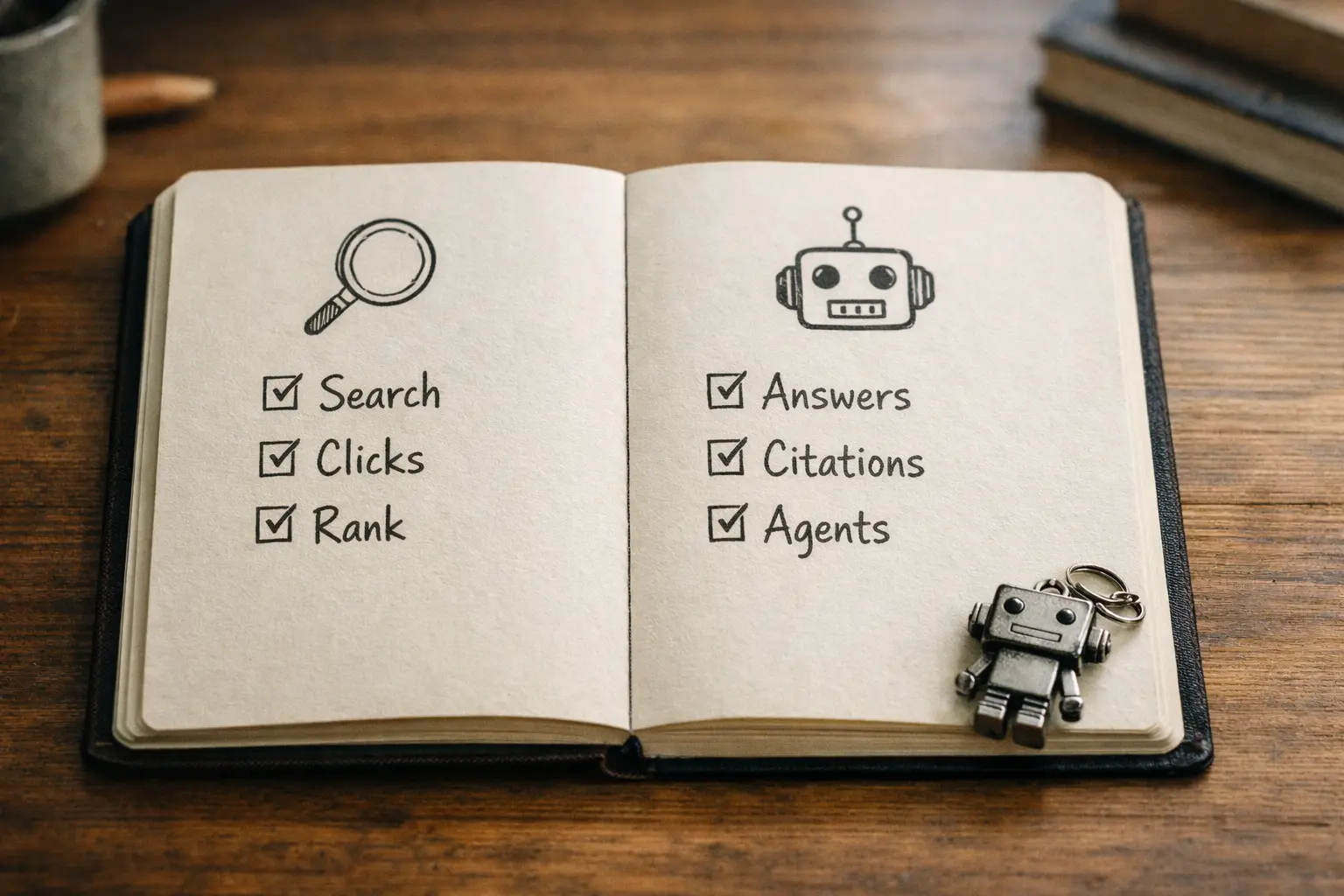
AI SEO / GEO in 2026: Your Next Customers Aren’t Humans — They’re Agents
Search is shifting from clicks to answers. Bots and AI agents crawl, cite, recommend, and increasingly buy. Learn what AI SEO / GEO means, why classic SEO is no longer enough, and how PAS7 Studio helps brands win visibility in the agentic web.
What you’ll get from this article
This isn’t a “how-to guide” for DIY optimization. It’s a reality check: the buyer journey is splitting in two—humans and agents—and your marketing strategy has to follow.
Search is becoming answers, not clicks
For the last decade, SEO meant a simple bargain: you publish, Google ranks, users click.
That bargain is breaking.
AI search experiences (Google AI Overviews, chat-based search, in-app assistants) increasingly satisfy intent without sending the user to your site. When clicks do happen, they are more selective—often concentrated on sources explicitly cited in AI summaries. [1][2]
One study summarized by The Guardian (via Authoritas) reported that when results appear below an AI Overview, a site that used to rank #1 can lose roughly 79% of traffic for that query. The same Guardian piece also references a Pew Research Center survey showing users clicked a link under an AI summary only about once per 100 searches. [3]
And this is part of a longer trend: in SparkToro/Datos clickstream research, for every 1,000 Google searches in the U.S., only about 360 clicks go to the open web (non-Google-owned, non-ad destinations). That’s before you even factor in where AI summaries push behavior next. [2]
This is the context behind what Forbes framed as “The 60% Problem”: a world where the majority of search journeys don’t end in a website visit—and your analytics never sees the customer who was still influenced by your content. [11]
The web is now crawled by agents first, humans second
AI SEO / GEO starts with a mindset shift: a growing portion of your “audience” doesn’t have eyeballs. It has parsers, scrapers, tool calls, and procurement workflows.
This matters for one reason: agents don’t “browse.” They ingest, summarize, cite, and decide.
If your product, documentation, pricing, and trust signals are not machine-legible and citeable, you can be effectively invisible—even if you still “rank.”
Meanwhile, the web is also being flooded with low-quality AI-generated content designed to farm attention and exploit recommendation loops. Kapwing’s research estimates that 21–33% of a new YouTube Shorts feed can be AI-generated “slop/brainrot” content. That noise makes trusted, well-structured sources more valuable than ever—especially to systems trying to answer reliably. [12]
51% automated
Imperva reports 51% of all internet traffic was automated in 2024, surpassing human traffic. [4]
1.7B GPTBot requests
DataDome reports GPTBot alone made over 1.7B requests to protected sites in August 2025. [5]
88.9% block GPTBot
DataDome reports 88.9% of robots.txt files in its dataset explicitly disallow GPTBot—evidence of rising concern over scraping and misuse. [5]
Visibility > clicks
If answers and agents become the interface, you win by being the source they choose—not by ranking for a human to click.
Automated traffic surpassed human traffic for the first time in 2024 (Imperva/Thales). Source: [4]
Section bots-are-the-audience screenshotLLM crawler traffic surged in 2025; GPTBot alone made 1.7B requests in Aug 2025 (DataDome Global Bot Security Report 2025). Source: [5]
Section bots-are-the-audience screenshotAgents don’t just recommend—they can spend money
The mental model most teams still have is: “AI = a chatbot that answers questions.”
But the market is moving toward agentic commerce: AI systems that research, compare options, and complete purchases.
Visa’s Intelligent Commerce initiative is explicitly about empowering AI agents to shop and buy within a payments ecosystem, and major outlets covered Visa’s push to let AI agents transact on users’ behalf with controls like budgets and preferences. [6][7]
OpenAI’s Operator was introduced as a browser-based agent that can handle tasks like filling forms and ordering groceries. That’s not a niche demo—it’s a preview of how buying decisions start to move upstream, into the assistant interface. [8]
Now connect this to traffic and conversion: Adobe Analytics reported generative-AI-referred traffic to U.S. retail sites jumped dramatically (e.g., +1,200% over a seven-month window), and Similarweb reported that ChatGPT-referred visits can convert at a higher rate than organic search in some ecommerce contexts. Even when volumes are smaller today, the intent can be unusually high. [13][14]
This is the core opportunity: agents are becoming a new class of buyer and recommender. And they will prefer sources that are clear, structured, trustworthy, and easy to verify.
The OpenClaw signal: agents can shift attention overnight
You don’t need to “believe in a trend.” You can watch it happen in public metrics.
OpenClaw is not the point by itself. It’s a signal: autonomous agents are mainstream enough to create sudden attention shifts—and your brand can either be legible to them or invisible.
100k+ GitHub stars
Reuters reported OpenClaw went viral quickly after launch and surpassed 100,000 GitHub stars, drawing massive attention. [9]
new “bot-native” surfaces
Once a tool becomes a default for agents, it spawns registries, plugins, templates, and dedicated communities—creating a new discovery channel.
trust gates matter
Reuters also notes security concerns and misconfigurations in real deployments—meaning “AI visibility” must be paired with security discipline. [9]
first movers win
When a new discovery interface forms, early structured sources become the default citations and recommendations.
OpenClaw’s star curve is a proxy for how fast agent ecosystems can capture attention. Chart source: [10]
Section openclaw-signal screenshotSo what is AI SEO / GEO, really?
AI SEO (sometimes called GEO—Generative Engine Optimization) is not “SEO with more keywords.”
It’s the discipline of making your brand and your knowledge easy for AI systems to:
- discover (crawlers + parsers),
- trust (authority + provenance),
- cite (stable, specific, verifiable claims),
- and act on (clear offers, pricing, constraints, and next steps).
In a click-driven world, ranking was the goal. In an answer-driven world, being selected as a source is the goal.
That shift is visible in performance data: Search Engine Land summarized Seer Interactive’s findings that AI Overviews correlated with major CTR drops (organic and paid) on affected queries—while brands cited in AI Overviews earned more clicks than those not cited. The lesson is blunt: citations and visibility are the new conversion funnel entrance. [1]
What PAS7 Studio does for AI SEO / GEO
Most companies are still optimizing products, services, and websites as if humans are the only audience. That’s the gap.
PAS7 Studio helps you compete for the next audience: AI agents, AI search systems, and automated decision-makers.
We do this as a service (not as a blog tutorial), typically in three layers:
- AI Visibility Audit (GEO readiness): what agents can parse, what they can’t, and where you’re losing citations.
- Authority & Citeability Layer: turning “marketing pages” into evidence-backed, source-friendly pages that assistants are comfortable referencing.
- Machine-legible Offer Layer: making your services and products easy to understand and act on (clear scope, pricing signals, constraints, and next actions).
If you’re serious about winning in the agentic web, you need both: visibility and trust. And you need it before competitors lock in “default source” status.
FAQ
No. Classic SEO optimizes for rankings and clicks. AI SEO / GEO optimizes for being selected, cited, and recommended in answer-driven interfaces—where clicks can drop dramatically and visibility becomes the new entry point. [1][3]
No. Ecommerce, B2B services, and SaaS are affected too. Adobe and Similarweb show AI-driven referrals are growing and can represent high-intent traffic—even when volumes are still small today. [13][14]
Because bots are increasingly the consumers of your information. Imperva reports automated traffic surpassed human traffic in 2024, and DataDome reports massive growth in LLM crawler activity. If agents can’t parse and trust your content, they won’t cite or recommend you. [4][5]
Agentic commerce is already being built into payment and shopping ecosystems. Visa publicly positioned AI agents as buyers within its network, and OpenAI introduced browser-based agents designed to complete tasks like ordering groceries. [6][7][8]
We provide AI visibility audits and implementation work that makes your brand machine-legible and citeable across AI search and agent workflows—so you can compete for the next audience: agents. Start with a free 15-minute intro call; deeper work is paid and tailored. (See service details: /prices/en/ai-seo-optimisation)
Sources
We only used sources that directly support the claims made above. Image sources are included where applicable.
AI agents are already choosing vendors — will they choose you?
This is the new game: not only humans browsing Google, but agents summarizing, citing, recommending, and purchasing on behalf of humans. If your brand isn’t machine-legible and citeable, it can be skipped—even if your human SEO looks “fine.” We offer a **free 15-minute intro call** to understand your situation. Deeper audits and implementation work are paid and tailored to your stack and market.
Related Articles

How to Add Mau Saver to a Telegram Group and Save Media in Chat
A practical guide to adding Mau Saver to a Telegram group and downloading videos, audio, and posts directly in the chat.

How to Advertise to an International Telegram Media Audience
A practical guide for advertisers: reach an international Telegram audience through Mau Saver Bot, group placements, pinned posts, and native media integrations.
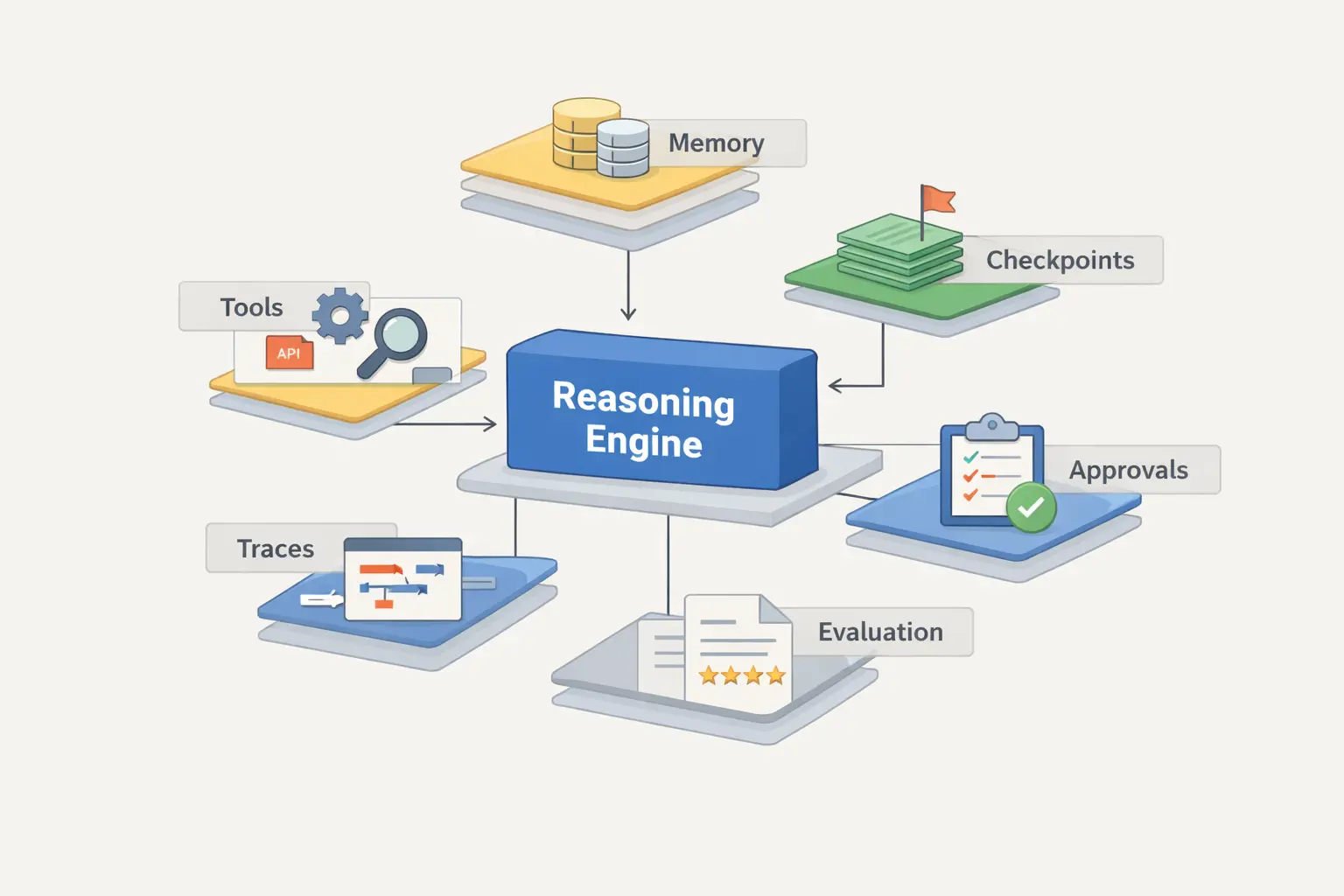
AI Assistant Development Cost in 2026: RAG Chatbots, CRM Integrations, Guardrails, and Support
A practical buyer guide to AI assistant development cost in 2026: prototypes, RAG chatbots, knowledge-base assistants, CRM and website integrations, guardrails, evaluations, monitoring, and support.

AI Can Make More. Not Better: What Game Development Research Actually Says
Generative AI is entering game production, but the evidence is more nuanced than the hype. We examine developer adoption, player reception, quality risks, and a practical production model for using AI without outsourcing taste.