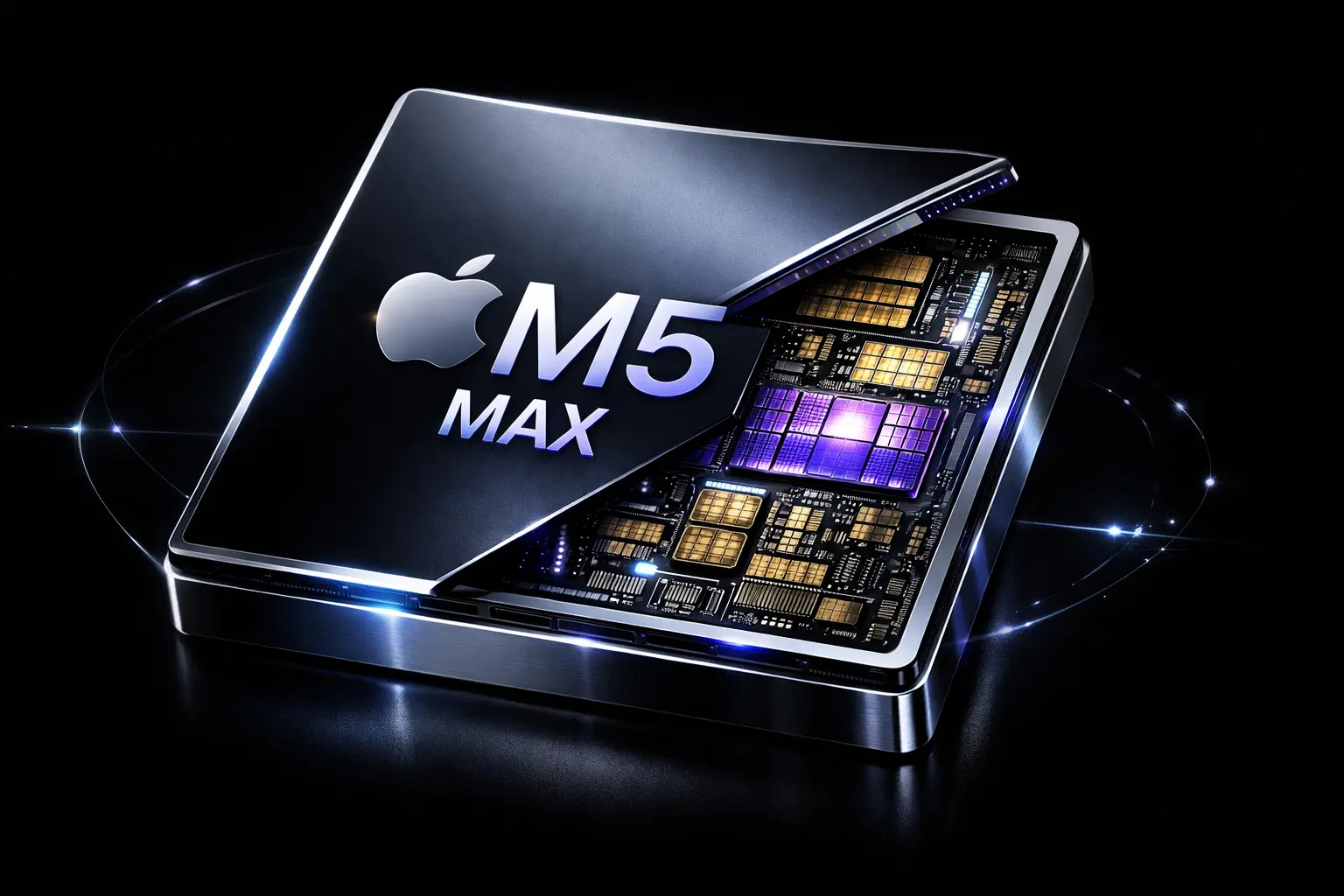
The most powerful Apple chip yet? M5 Pro and M5 Max are breaking records
A data-backed March 2026 analysis of Apple M5 Pro and M5 Max. We break down why these chips can credibly be called Apple's most powerful pro laptop silicon, how they compare with M4 Pro, M4 Max, M1 Pro, M1 Max, and how they stack up against Intel and AMD laptop rivals.
Yes, M5 Pro and especially M5 Max have a credible case as Apple's most powerful pro laptop chips so far. Apple's own March 2026 launch data shows large gains in AI and graphics-heavy workflows, while early Geekbench 6 CPU results also place them ahead of earlier Apple Pro and Max generations and above current Intel Core Ultra 9 285H and AMD Ryzen AI Max+ 395 in single-core and multi-core CPU scores. [1][2][5][6][12][14]
Bite to read: the shortest honest version of the story
As of March 8, 2026, the strongest reading is not hype-free, but it is evidence-backed.
What actually changed in M5 Pro and M5 Max
Apple's March 2026 pitch for these chips is broader than in some earlier generations. The company is not framing M5 Pro and M5 Max only as faster CPUs or only as better GPUs. It is framing them as a platform jump: a new Fusion Architecture, a new 18-core CPU design, stronger GPU behavior for AI and ray tracing, higher memory bandwidth, faster storage in the new MacBook Pro systems, and more aggressive local AI positioning. [1][2]
The CPU side is especially notable. Apple says M5 Pro and M5 Max use a new 18-core CPU with 6 super cores and 12 all-new performance cores. That is a different structure from M4 Pro's up-to-14-core CPU and M4 Max's up-to-16-core CPU, and a much larger jump from the 10-core layouts in M1 Pro and M1 Max. [1][3][4]
The memory story is just as important. M5 Pro reaches 307GB/s of unified memory bandwidth, while M5 Max reaches 614GB/s. For context, Apple's M4 Pro sits at 273GB/s, M4 Max at 546GB/s, M1 Pro at 200GB/s, and M1 Max at 400GB/s. If your work is sensitive to large scenes, big video timelines, high-token local models, or memory-heavy dev tools, this matters as much as raw CPU score. [1][3][4]
Why these chips can credibly be called Apple's most powerful pro laptop chips yet
The claim is strongest when you break it into separate dimensions instead of treating 'most powerful' as one vague adjective.
1. Apple's own workload claims are not small
On the new MacBook Pro systems, Apple says M5 Pro can deliver up to 7.8x faster AI image generation than M1 Pro and 3.7x faster than M4 Pro; up to 6.9x faster LLM prompt processing than M1 Pro and 3.9x faster than M4 Pro; and up to 5.2x faster 3D rendering in Maxon Redshift than M1 Pro and 1.4x faster than M4 Pro. [2]
For M5 Max, Apple's launch page claims up to 8x faster AI image generation than M1 Max and 3.8x faster than M4 Max; up to 6.7x faster LLM prompt processing than M1 Max and 4x faster than M4 Max; and up to 5.4x faster video effects rendering in DaVinci Resolve Studio than M1 Max and 3x faster than M4 Max. [2]
2. Apple's chip-level claims are broader than CPU-only
Apple's chip launch says M5 Pro raises multithreaded CPU performance by up to 30 percent over M4 Pro in pro workloads, while M5 Max raises multithreaded CPU performance by up to 15 percent over M4 Max. It also says graphics performance is up to 20 percent above the M4 generation and up to 2.2x above the M1 generation for both Pro and Max lines, with up to 35 percent more ray-tracing performance over M4 Pro and M4 Max. [1]
3. Storage and platform behavior also moved
This matters because many buyers will experience these chips through the 2026 MacBook Pro systems, not on a lab bench. Apple says the new machines deliver up to 2x faster SSD read/write performance than the previous generation and reach up to 14.5GB/s. That does not make the chip itself faster, but it does make the end-to-end pro workflow feel meaningfully faster in large project files, model checkpoints, and high-resolution media work. [2]
18 cores
M5 Pro and M5 Max both move to a new 18-core CPU layout with 6 super cores and 12 performance cores. [1]
307 / 614GB/s
M5 Pro and M5 Max both increase unified memory bandwidth over M4 Pro and M4 Max, and far beyond M1 Pro and M1 Max. [1][3][4]
Up to 4x
Apple says M5 Pro and M5 Max deliver up to 4x faster LLM prompt processing than M4 Pro and M4 Max in the new MacBook Pro systems. [2]
How M5 Pro and M5 Max compare with M4 and M1 Pro/Max generations
The clearest way to read the generational story is to split the Pro line and the Max line. M5 Pro is the balanced high-end chip. M5 Max is the absolute top-end chip.
Pro line: M1 Pro vs M4 Pro vs M5 Pro
| Chip | CPU layout | Unified memory ceiling | Memory bandwidth | CPU signal used here | Notes |
|---|---|---|---|---|---|
| M1 Pro | 10-core CPU | Up to 32GB | 200GB/s | 2399 / 12619 Geekbench 6 single / multi | First Pro-class Apple silicon jump for MacBook Pro. [4][9] |
| M4 Pro | Up to 14-core CPU | Up to 64GB | 273GB/s | 3877 / 22483 Geekbench 6 average | Big CPU and bandwidth step over M1 Pro. [3][7] |
| M5 Pro | Up to 18-core CPU | Up to 64GB | 307GB/s | 4242 / 28111 early Geekbench 6 result | Strongest Pro-line CPU and AI/workflow jump so far. [1][2][5] |
Max line: M1 Max vs M4 Max vs M5 Max
| Chip | CPU layout | Unified memory ceiling | Memory bandwidth | CPU signal used here | Notes |
|---|---|---|---|---|---|
| M1 Max | 10-core CPU | Up to 64GB | 400GB/s | 2416 / 12512 Geekbench 6 result | First true Apple laptop workstation chip. [4][10] |
| M4 Max | Up to 16-core CPU | Up to 128GB | 546GB/s | 3883 / 25629 Geekbench 6 average | Huge jump over M1 Max, especially in GPU and memory. [3][8] |
| M5 Max | Up to 18-core CPU | Up to 128GB | 614GB/s | 4353 / 29644 early Geekbench 6 result | The strongest Max line yet across CPU, memory bandwidth, and AI-oriented workload claims. [1][2][6] |
The clean bottom line is this: the biggest practical leaps will be felt by M1 Pro and M1 Max upgraders. M4 Pro and M4 Max owners already have excellent machines, so for them the upgrade case depends much more on local AI, rendering, or memory-heavy workflows than on general-purpose responsiveness alone. [1][2][3][4]
Against Intel and AMD, Apple still has the cleaner top-end laptop story in this slice of data
This table compares early Apple M5 Pro and M5 Max CPU results with one current Intel mobile flagship and one current AMD AI-focused mobile flagship. It is not a whole-laptop verdict, but it is a useful CPU signal.
| Comparison point | M5 Pro (early GB6) | M5 Max (early GB6) | Intel Core Ultra 9 285H | AMD Ryzen AI Max+ 395 |
|---|---|---|---|---|
| Geekbench 6 single-core | 4242 | 4353 | 2612 | 2766 |
| Geekbench 6 multi-core | 28111 | 29644 | 14797 | 17579 |
| Cores / threads | 18 / 18 | 18 / 18 | 16 / 16 | 16 / 32 |
| Memory story | Up to 64GB, 307GB/s | Up to 128GB, 614GB/s | LPDDR via laptop design | Platform-specific unified memory approach |
| Best fit | Balanced pro work | Maximum GPU/AI ceiling | General mobile x86 | AI-heavy x86 mobile |
Summary
The practical takeaway is not that Intel and AMD are irrelevant. It is that Apple has moved the ceiling again, especially for users who value CPU speed, memory bandwidth, and local AI workflows in one machine.
Three easy mistakes when reading M5 Pro and M5 Max performance claims
This is the part that keeps the article honest. Apple's chips look extremely strong, but the data still has to be read correctly.
Summary
The strongest conclusion is not 'Apple wins everything.' The strongest conclusion is that Apple currently has the strongest premium pro laptop silicon story if your workload aligns with what these chips are designed to do.
Upgrade decision grid: who should care most about M5 Pro and M5 Max
The generational jump is real, but not every buyer should read it the same way.
M1 Pro or M1 Max owners
M4 Pro owners
Summary
The biggest winners are M1 generation upgraders. The smallest-value upgrade path is M4 Max to M5 Max unless your workload is already living at the edge.
FAQ
Yes in absolute ceiling, especially for GPU-heavy, AI-heavy, and bandwidth-heavy work. M5 Max has up to 40 GPU cores, up to 128GB unified memory, and up to 614GB/s bandwidth. M5 Pro is still the more balanced chip for many pro users. [1][2]
It looks meaningful, but the size of the jump depends on workload. Apple's own launch data is much more dramatic for AI image generation, LLM prompt processing, and rendering than it is for generic everyday work. Early Geekbench CPU data also shows a solid lead, but not a generational revolution on every axis. [1][2][5][7]
In the Geekbench 6 CPU data used here, yes. M5 Max and M5 Pro are both ahead of Intel Core Ultra 9 285H and ahead of AMD Ryzen AI Max+ 395 in both single-core and multi-core CPU score. That still does not make them automatic winners for every workflow or software stack. [5][6][12][14]
M1 Pro and M1 Max owners are the clearest upgrade audience. M4 Pro and M4 Max owners should upgrade mainly if their work is now more AI-heavy, more memory-bound, or more graphically demanding than it was when they bought their current machines. [1][2][3][4]
No. It can support a strong case that they are Apple's most powerful pro laptop chips yet, and that they compare extremely well in the sources used here. But software ecosystem fit, app support, thermals, battery behavior, and pricing still decide real buyer value. [1][2][5][6][11][13]
Sources
Primary sources and benchmark pages checked on March 8, 2026. Apple workload claims are Apple-run tests; Geekbench data below is third-party browser data and should be read as an external signal, not as an app-specific verdict.
Related Articles

How to Add Mau Saver to a Telegram Group and Save Media in Chat
A practical guide to adding Mau Saver to a Telegram group and downloading videos, audio, and posts directly in the chat.

How to Advertise to an International Telegram Media Audience
A practical guide for advertisers: reach an international Telegram audience through Mau Saver Bot, group placements, pinned posts, and native media integrations.

AI Assistant Development Cost in 2026: RAG Chatbots, CRM Integrations, Guardrails, and Support
A practical buyer guide to AI assistant development cost in 2026: prototypes, RAG chatbots, knowledge-base assistants, CRM and website integrations, guardrails, evaluations, monitoring, and support.

AI Can Make More. Not Better: What Game Development Research Actually Says
Generative AI is entering game production, but the evidence is more nuanced than the hype. We examine developer adoption, player reception, quality risks, and a practical production model for using AI without outsourcing taste.