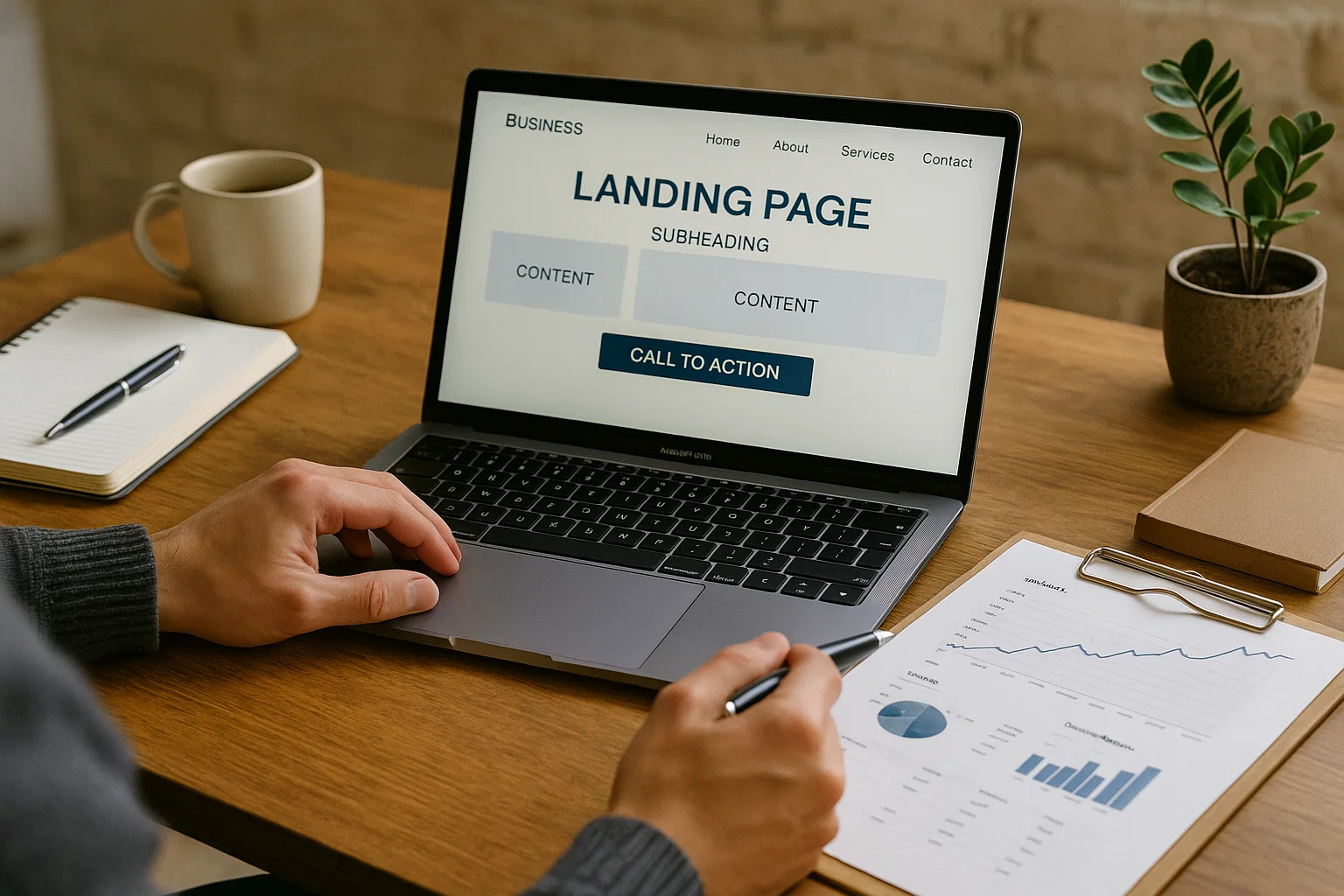
Business Landing vs Company Website in 2025
Learn what a business landing page is, how it differs from a full company website, and how to build a fast, SEO-first site that actually brings clients.
What this guide covers
This guide is for founders, solo entrepreneurs, agencies and small teams who want a professional website but are unsure what a “business landing” or a “company website” means in practice in 2025.
You will learn how a conversion-focused landing differs from a multi-page company website, what sections matter most, how this connects to SEO and performance, and when it makes sense to build it yourself versus hiring a studio.
By the end, you will have a clear blueprint you can adapt into a structured site that works as a trust asset, an inbound sales channel, and a long-term SEO platform.
Why your business website matters in 2025
A modern company website is no longer a static online brochure. Search engines increasingly reward content that is genuinely helpful, clearly structured, and written for real people rather than for keyword stuffing. If the page fails to answer user intent clearly, it becomes harder to rank and easier to replace. [1]
Research consistently shows that search is still the main starting point for many online journeys, which makes your website the first “real” brand interaction for a lot of potential clients. That first impression often decides whether users continue, bounce, or compare a competitor. [2][6]
What is a business landing page?
A business landing page is a purpose-built, conversion-focused website that explains what you do, who it’s for, and why the visitor should trust you enough to contact you.
It usually concentrates on one core offer, and it combines messaging, UX, SEO fundamentals, and performance into one coherent page flow designed to guide the visitor to a clear next step. [6]
Business landing vs full company website
A business landing page focuses on one core offer, while a full company website covers a broader ecosystem: multiple services, industries, case studies, careers, and often a content hub.
In practice, many companies start with a focused landing to validate positioning and generate leads quickly, then evolve into a larger company website as they expand services and invest in SEO-driven content. [2][5]
For a new or repositioned business, a structured landing is often the fastest way to launch a professional, SEO-ready presence without turning it into a multi-month multi-page product.
Key differences in structure and scope
From an architecture and UX point of view, the difference between a business landing and a company website is less about technology and more about scope, depth and content strategy.
Business landing: focused scope
One main page (plus legal pages) that concentrates on a single product or service line. Ideal when you want to dominate one clear search intent and convert highly targeted visitors.
Company website: broader ecosystem
Multiple sections and page types: services, industries, blog, case studies, careers, about, resources. Better for established brands that invest in long-term content and SEO.
Landing navigation: simple
Hero, services overview, workflow, proof, pricing and contact. Navigation usually scrolls through sections or links to one to three extra pages at most.
Company navigation: multi-layered
Main nav with dropdowns, per-service pages, category hubs and many internal links. Requires more planning, content design and technical SEO work.
Essential structure of a high-converting business landing
PAS7 Studio uses a repeatable structure for business landings that balances search intent, UX and conversion. You can adapt the same blueprint for your own website.
The goal is to make the first screen instantly clear, reduce doubt with proof, and remove friction from discovery to the CTA. That’s how you build trust and improve conversion without gimmicks. [6][5]
Hero: who you are, what you do, for whom and one clear CTA.
Services overview: short summaries of what you offer and who benefits.
Features and differentiation: why your approach is better than alternatives.
Workflow: how collaboration looks step by step, from first call to launch.
Proof: portfolio, case studies, screenshots, logos and testimonials.
About: who is behind the work, experience, values and background.
Numbers: concrete metrics such as users served, products completed and performance improvements.
Pricing or packages: transparent starting points and what is included.
FAQ: real questions from clients, answered in one to three sentences each.
Contact and support: multiple easy ways to reach you or book a call.
Realistic case and numbers example
Below is an anonymised yet realistic snapshot of what often happens when a company moves from a generic template website to a structured, SEO-first business landing.
These results are not “magic”. They typically come from aligning content with intent, making the hero instantly understandable, adding credible proof, and removing UX friction that stops users from acting. [6][5]
+70%
Growth in organic sessions over three to six months after launching a content-structured landing with clearer intent matching and internal linking. [2][1]
+30–60%
Relative uplift in the percentage of visitors who submit a form or request a quote compared to generic landing pages. [5]
Good (75%+)
Share of visits meeting recommended thresholds for performance and user experience signals. [3][4]
−20–30%
Drop in immediate exits thanks to clearer first impression, better hierarchy and reduced friction above the fold. [6]
Do it yourself or hire a studio?
If you’re comfortable with design tools, builders and copywriting, you can build a first version of a business landing yourself. That often works for very small, local, or early-stage products.
However, if inbound leads matter or you target competitive queries, the cost of a weak site becomes real. In that case, investing in strong architecture, performance and intent-led content is usually more efficient than iterating endlessly on a template. [1][3][5]
A simple rule: if getting the website wrong costs more than building it properly, treat it as an investment, not an experiment.
Where DIY works and where it breaks
Use the overview below as a quick diagnostic to decide whether to prototype on your own or start with a professional setup immediately.
Good fit for DIY
You have one simple service, you do not rely heavily on search yet, and you only need a presentable web presence while you validate your offer.
Requires a studio
You target competitive queries, need multilingual SEO, rely on content marketing, or integrate with CRMs, analytics or automation systems.
Temporary DIY, later studio
You want to launch fast, gather feedback, and reinvest into a higher-end site after your positioning is validated.
Studio from day one
Your brand is established, you work in high-trust markets, or you expect serious traffic and cannot risk slow performance or unclear messaging.
FAQ
If you sell one main service and do not need complex content, a one-page business landing can be enough. As soon as you add more services, languages or SEO topics, you will likely evolve into a multi-page company website.
If you want to grow organic traffic, yes. A blog or content hub lets you cover a full cluster of topics, support long-tail search and build topical authority around your services.
For scalable products, a Next.js-based stack with static generation and image optimization is a strong default. For simple setups, no-code builders can be enough, but custom stacks offer deeper SEO and performance control.
Typically one to six weeks, depending on content readiness, design complexity, and integrations such as analytics, booking, or multilingual support.
Budgets vary, but in many cases a professional landing costs less than the revenue lost from running a weak, confusing, or slow website for a year.
Yes. Many businesses start on builders and migrate once they outgrow limitations or want deeper SEO control and better performance.
Check basics: search visibility, conversion rate, Core Web Vitals, clarity of the hero section, and recurring user confusion. If multiple areas are weak, it’s time to redesign your structure and messaging.
Sources and further reading
Useful references for the concepts and benchmarks used in this article.
Ready to plan your own business landing or company website?
If you want a website that loads fast, ranks in search and clearly explains what you do in a way that converts, it is worth investing in proper architecture and execution. [3][4][1] PAS7 Studio builds SEO-first, high-performance business landings and company websites using a modern stack, clean code and measurable goals, so your site becomes an asset instead of a liability.
Related Articles

How to Add Mau Saver to a Telegram Group and Save Media in Chat
A practical guide to adding Mau Saver to a Telegram group and downloading videos, audio, and posts directly in the chat.

How to Advertise to an International Telegram Media Audience
A practical guide for advertisers: reach an international Telegram audience through Mau Saver Bot, group placements, pinned posts, and native media integrations.
AI Assistant Development Cost in 2026: RAG Chatbots, CRM Integrations, Guardrails, and Support
A practical buyer guide to AI assistant development cost in 2026: prototypes, RAG chatbots, knowledge-base assistants, CRM and website integrations, guardrails, evaluations, monitoring, and support.

AI Can Make More. Not Better: What Game Development Research Actually Says
Generative AI is entering game production, but the evidence is more nuanced than the hype. We examine developer adoption, player reception, quality risks, and a practical production model for using AI without outsourcing taste.
Turnkey Website Development
Website development services for business: landing pages, corporate websites, and ecommerce builds with integrations, fast performance, and SEO-ready architecture.
Technical SEO Audit & SEO Optimization
Technical SEO audit and SEO optimization services: indexation fixes, Core Web Vitals improvements, schema markup, internal linking, and sustainable organic growth.