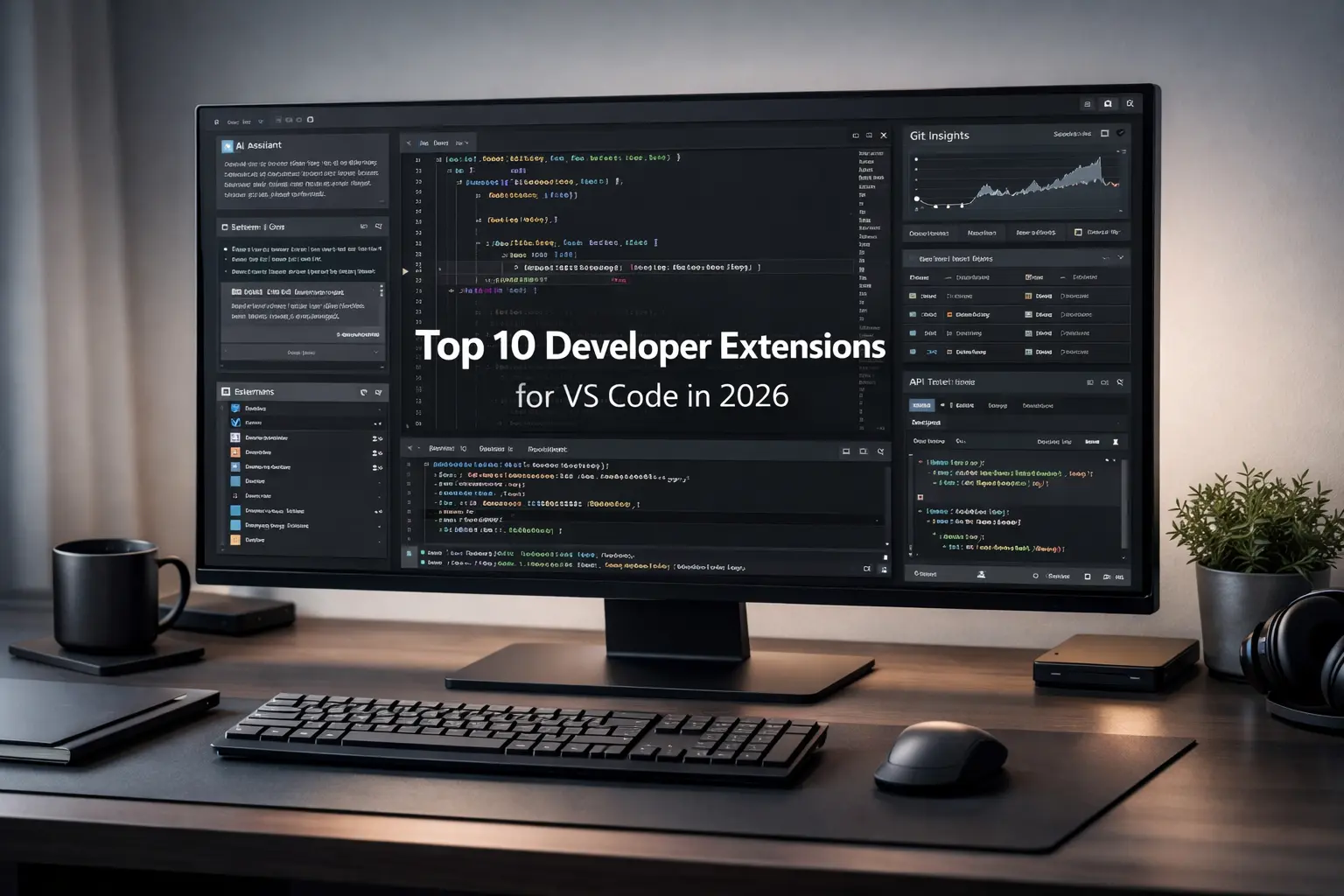
Top 10 best extensions for developers in 2026: the VS Code stack worth installing first
A practical 2026 ranking of the best VS Code extensions for developers: the classic must-haves, the AI tools that are actually useful now, current install counts, and a cleaner way to build an editor stack without overlap.
Short version: these ten give the best mix of popularity, AI leverage, and daily usefulness
As of March 3, 2026, this is the strongest practical top ten for developers working in VS Code.
GitHub Copilot remains the most influential extension because it now works as a broader agent layer, not just inline completion. [1][2][3]
Prettier, ESLint, and GitLens still form the classic baseline because AI does not replace formatting, static analysis, or Git visibility. [4][5][6][7][8]
Why this article focuses on VS Code
This article focuses specifically on VS Code. That is deliberate. In 2026, VS Code still has the most measurable extension ecosystem, the clearest Marketplace install data, and the broadest overlap between frontend, backend, DevOps, and AI-assisted workflows.
That also makes this ranking more honest. Instead of vague best tools for developers advice, we can compare real install numbers, official extension capabilities, and how these tools fit into a modern workflow. The point is not to install everything. The point is to build a stack that speeds you up without making the editor noisy.
What makes an extension top-tier in 2026
This ranking uses four filters instead of one crude popularity metric.
2026-first
An extension needs to solve a current workflow problem, not just carry old install momentum from previous years.
high-touch
The best extensions are touched often: on save, in review, in debugging, in requests, or during AI-assisted coding loops.
real installs
Install counts still matter because they show the tool has survived contact with real teams and real repositories.
less noise
A strong stack reduces duplicate diagnostics, duplicate formatting, and redundant side panels instead of multiplying them.
The same shortlist sorted by public install count
This table is the raw adoption view, sorted from largest to smallest public install count where a comparable number exists.
| Order by installs | Extension | Public install signal | Why it stays on the shortlist |
|---|---|---|---|
| 1 | GitHub Copilot | 71,876,900 installs | Still the most influential AI layer in VS Code. [1][2][3] |
| 2 | Prettier | 66,072,863 installs | The formatting baseline for deterministic team output. [4][5] |
| 3 | ESLint | 48,604,483 installs | The core correctness layer for JavaScript and TypeScript-heavy work. [6][7] |
| 4 | GitLens | 47,762,340 installs | The fastest way to understand authorship, history, and context without leaving the editor. [8] |
| 5 | Tailwind CSS IntelliSense | 12,953,806 installs | A near-essential speed tool in Tailwind-heavy teams. [18][19] |
| 6 | Thunder Client | 6,679,789 installs | Keeps API testing and request iteration inside the editor. [16][17] |
| 7 | Cline | 3,207,713 installs | A serious autonomous coding agent for task execution inside the IDE. [14][15] |
| 8 | Continue | 2,241,143 installs | One of the strongest open AI coding layers for teams that want more control. [12][13] |
| 9 | Kilo Code | 700,000+ downloads | A fast-growing open-source agent extension with parallel tabs and broad model choice. [20][21][22] |
| 10 | Codex | Public preview in VS Code | A strategically important OpenAI agent workflow, but not yet exposed through a comparable public Marketplace install count. [9][10][11] |
This is exactly why raw adoption and actual usefulness are not the same thing in 2026. Codex is strategically important even without a comparable Marketplace install number, and Kilo Code is moving fast enough that simple install totals alone understate its relevance.
The first five are your foundation
These are the extensions that usually deliver value regardless of whether you build web apps, APIs, internal tools, or infrastructure-heavy products.
GitHub Copilot in a modern VS Code workflow, showing how AI suggestions and agent interactions sit directly next to production code. [1][2][3]
Section picks-1-5 screenshotPrettier remains the formatting baseline because it keeps code output predictable across teams and repositories. [4][5]
Section picks-1-5 screenshotESLint gives developers immediate feedback on code quality and rule violations before those issues reach CI. [6][7]
Section picks-1-5 screenshotGitLens turns version control history into live context inside the editor, which is especially useful in larger codebases. [8]
Section picks-1-5 screenshot1. GitHub Copilot
Copilot holds the first spot because in 2026 it is no longer just suggestion ghost text. VS Code now supports local, background, cloud, and third-party agent sessions under the broader Copilot workflow, which changes how planning, refactoring, debugging, and repetitive implementation happen inside the editor. [2][3] The main reason it wins is coverage: most developers can get value from it immediately, even before tuning anything deeply.
2. Prettier
Prettier stays near the top because every team still benefits from predictable formatting and cleaner diffs. Its value is almost boring now, which is exactly why it works. The extension remains the formatting baseline for projects that want consistency without arguing over style in code review. [4][5]
3. ESLint
ESLint is still the extension that turns correctness into a daily habit. The extension uses the ESLint library from your workspace, and the official docs are now fully centered around the modern configuration model. [6][7] In a TypeScript or JavaScript-heavy team, that makes it more important than any visual productivity add-on.
4. GitLens
GitLens remains one of the few extensions that feels useful every single day. Blame annotations, file history, commit graph, and pull request context are not flashy, but they remove a lot of context switching. [8] It is especially good in mature codebases where the question is rarely what does this code do? and more often why was this changed and by whom?.
5. Codex
Codex deserves a top-five slot because it reflects where AI-assisted development is going, not where it was a year ago. Official OpenAI material positions Codex as a multi-agent system that works across the app, CLI, IDE, and cloud, while GitHub's official docs already describe the VS Code integration as a Copilot-powered OpenAI Codex extension in public preview. [9][10][11] For developers who want deeper agent execution than classic chat and autocomplete, Codex is now part of the serious conversation.
The second five reflect what development work feels like in 2026
This half of the ranking is where the 2026 shift becomes obvious: more AI agents, more in-editor operations, and more workflow-specific productivity.
Continue gives teams a more open AI coding layer with repo-aware workflows and configurable model control. [12][13]
Section picks-6-10 screenshotCline is one of the clearest examples of autonomous task execution becoming part of the normal IDE workflow. [14][15]
Section picks-6-10 screenshotKilo Code focuses on parallel agent workflows and a broader model ecosystem for developers who want more control. [20][21][22]
Section picks-6-10 screenshot6. Continue
Continue earns a place because it represents the open, configurable side of AI coding. It has grown into an open-source AI code agent with stronger repo-aware workflows and better source-controlled checks. [12][13] That matters for teams that want AI help but do not want to lock their entire process into one closed assistant experience.
7. Cline
Cline is one of the clearest examples of the autonomous-agent wave becoming normal developer tooling. It can read and write files, run commands, use the browser, and work through tasks with explicit approval. [14][15] It is not for everyone, but in 2026 it is too useful to ignore if your team is serious about agent-driven implementation work.
8. Kilo Code
Kilo Code earns the eighth slot because it is one of the clearest open-source answers to the agentic editor trend. By early 2026, the VS Code extension had passed 700,000 downloads, and the product now leans heavily into parallel agent tabs and broad model choice. [20][21][22] For developers who want more openness and parallelism than mainstream commercial tools usually allow, that is a serious differentiator.
9. Tailwind CSS IntelliSense
This extension is not universal, but the install count is already high enough to show how central Tailwind has become in product teams. The extension still delivers autocomplete, linting, and hover support, and the current Marketplace docs clearly reflect Tailwind v4 activation patterns. [18][19] If Tailwind is in your stack, this is not a luxury extension. It is a speed tool.
10. Thunder Client
Thunder Client stays relevant because many developers still want to test APIs without opening another app. Its docs highlight local storage, scriptless testing, Git Sync, and CLI support, which is more serious than the old lightweight request tester label suggests. [16][17] For frontend, full-stack, and internal-tool developers, it remains a fast win.
Two extremely popular extensions that still matter, but no longer feel top ten by default
This is where install counts and current usefulness stop matching perfectly.
Live Server still has 74,959,196 installs and is absolutely useful for quick static previews, HTML/CSS experiments, and lightweight legacy work. [23] It misses the top ten only because modern frameworks already ship stronger built-in dev servers for many teams.
Path Intellisense still has 18,128,183 installs and remains convenient, but its own Marketplace page literally tells you to disable built-in JavaScript and TypeScript path suggestions if you want it to take over. [24] In 2026, that overlap is exactly why it falls just outside the top ten for most developers.
How to turn this top ten into a sane editor setup
The trick is not to install all ten blindly. The trick is to install them in layers.
The best developer setup in 2026 is not maximum extension count. It is maximum workflow coverage with minimum overlap. That usually means one AI layer, one linting layer, one formatting layer, one Git visibility layer, and only a few targeted extras.
Base layer
For almost any developer, the safest base is Prettier, ESLint, and GitLens. This gives you formatting, correctness, and history before AI even enters the picture.
AI layer
Choose one primary AI layer first. For most teams, that is GitHub Copilot or Codex, depending on whether the team wants broader Copilot coverage or a more agent-centric OpenAI workflow. Add Continue, Cline, or Kilo Code only when you know what unique workflow they improve. Otherwise you risk building a noisy editor with overlapping chat and agent surfaces.
Specialized layer
Use Tailwind CSS IntelliSense and Thunder Client only when those workflows are frequent enough to justify a permanent slot. That is how you keep the editor helpful instead of crowded.
FAQ
For most developers, the best first three are GitHub Copilot, Prettier, and ESLint. That gives you acceleration, formatting consistency, and correctness without overcomplicating the editor.
Not by default. Start with one primary AI layer and add another only when you know what unique workflow it improves. Otherwise the editor quickly turns into overlapping chat panels and duplicate agent surfaces.
Because in teams that ship Tailwind-heavy products every day, it behaves like an essential speed tool rather than a niche add-on. It is conditional, but when relevant it easily earns the spot.
Because install counts show historical popularity, not current universality. In 2026 many teams work inside framework-native dev servers, so Live Server is still useful but less broadly essential than its install count suggests.
Sources
Official Marketplace pages and official product docs checked on March 3, 2026.
Related Articles

How to Add Mau Saver to a Telegram Group and Save Media in Chat
A practical guide to adding Mau Saver to a Telegram group and downloading videos, audio, and posts directly in the chat.

How to Advertise to an International Telegram Media Audience
A practical guide for advertisers: reach an international Telegram audience through Mau Saver Bot, group placements, pinned posts, and native media integrations.
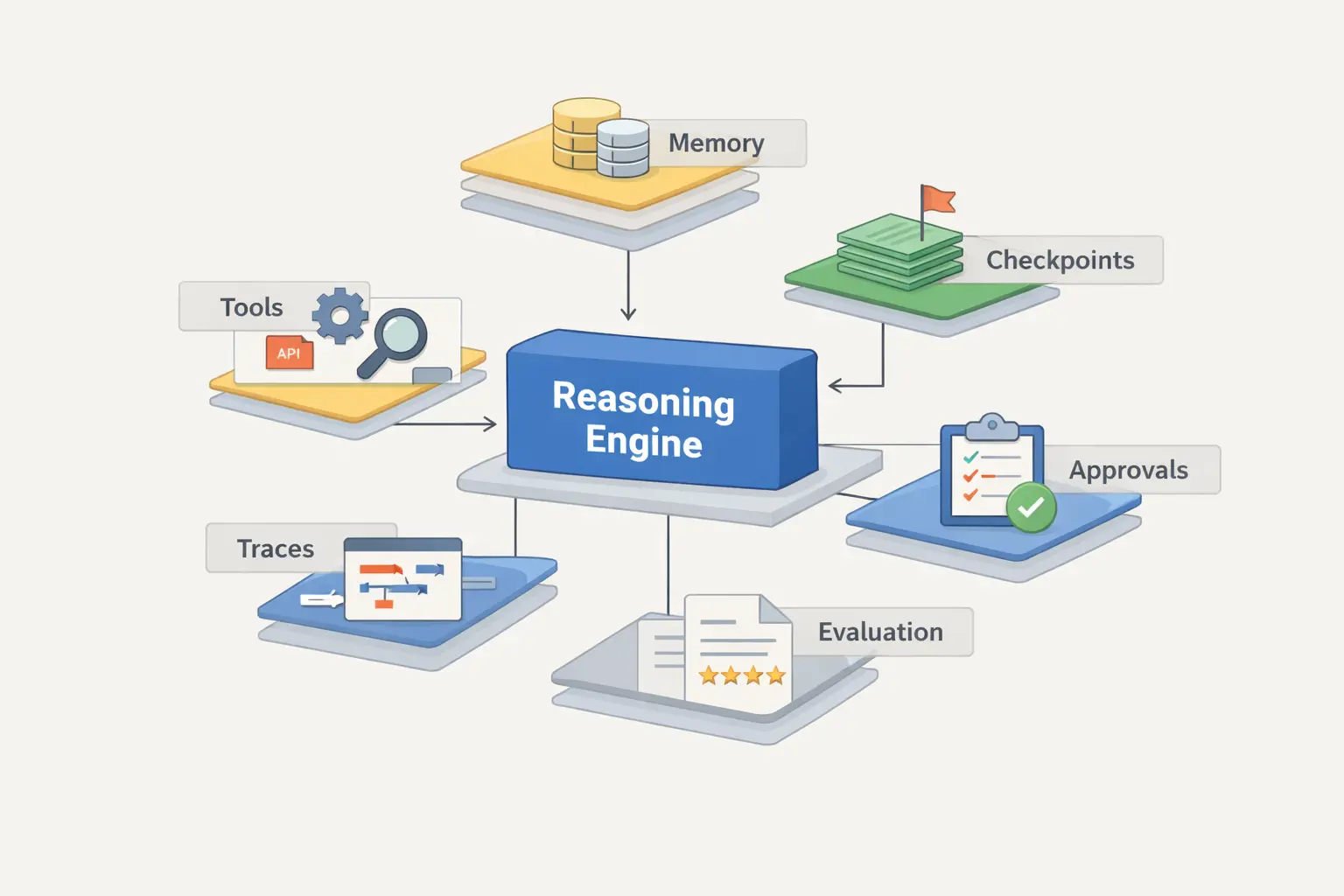
AI Assistant Development Cost in 2026: RAG Chatbots, CRM Integrations, Guardrails, and Support
A practical buyer guide to AI assistant development cost in 2026: prototypes, RAG chatbots, knowledge-base assistants, CRM and website integrations, guardrails, evaluations, monitoring, and support.

AI Can Make More. Not Better: What Game Development Research Actually Says
Generative AI is entering game production, but the evidence is more nuanced than the hype. We examine developer adoption, player reception, quality risks, and a practical production model for using AI without outsourcing taste.