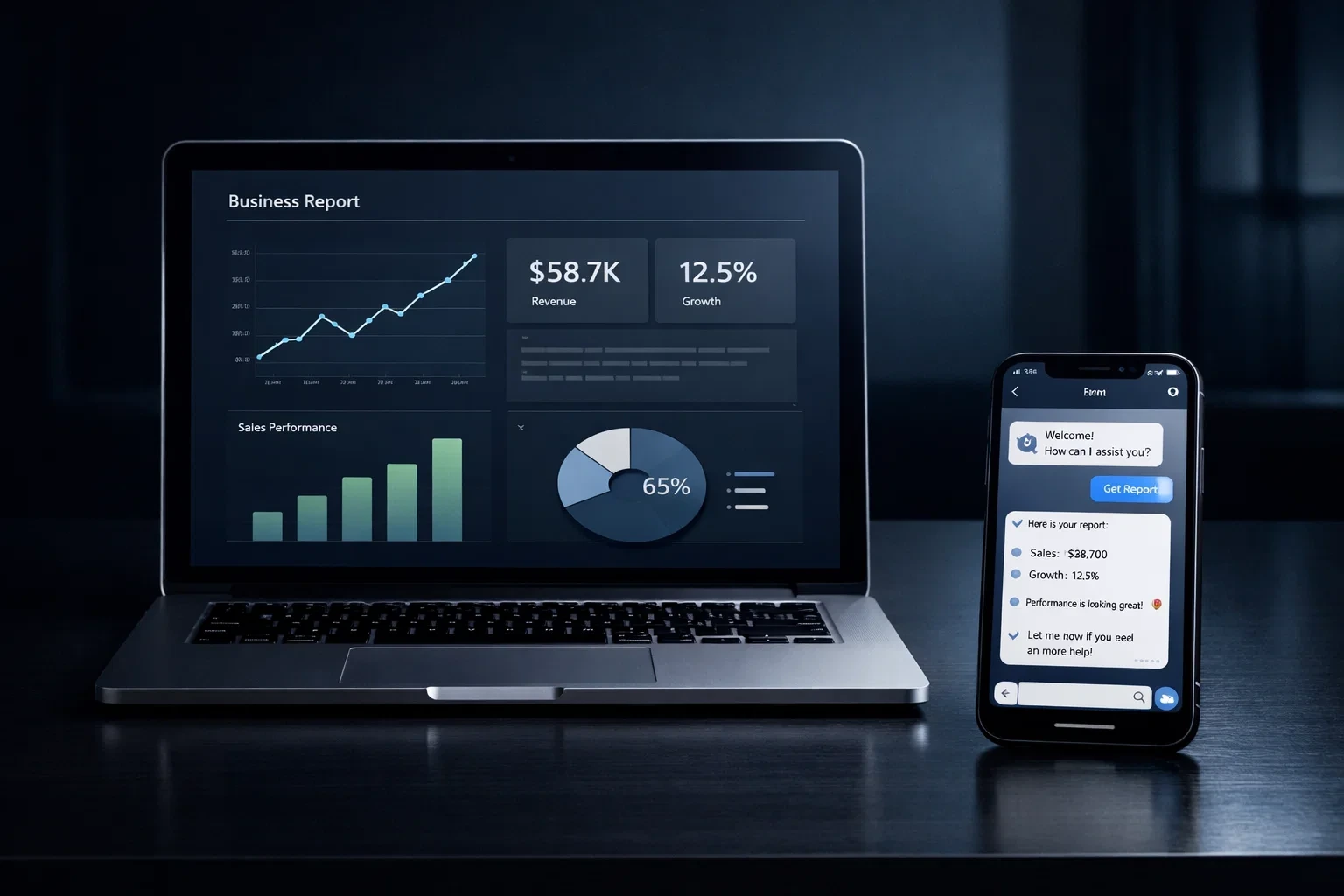
How much does a custom Telegram bot cost for business in 2026?
A practical 2026 cost breakdown for building a Telegram bot for business: what bots can do in Telegram, which bot types solve real business tasks, what drives the estimate (CRM, payments, Mini Apps, admin panels), realistic budget ranges, PAS7 Studio starting pricing, and how to scope a bot without hidden costs.
In 2026, a custom Telegram bot usually starts in the low-thousands for a narrow MVP and rises into the tens of thousands when you add CRM integrations, payments, Mini Apps, admin tools, analytics, and reliability hardening. Telegram itself is not the expensive part; software scope and operating responsibility are.
Quick answer: Telegram bot pricing in 2026
The short version: Telegram is rarely what makes your bot expensive. Scope, integrations, and long-term ownership do.
A practical visual map: MVP bots, integrated business bots, advanced systems, and ongoing support belong to different pricing bands for good reasons.
Section quick-answer-telegram-bot-cost-2026 screenshotWhat a Telegram business bot really is in 2026
A Telegram bot is not just a chat window with canned replies. Telegram positions bots as applications that connect to your own server, process updates, and communicate through an HTTPS-based Bot API. In business terms, that means even a modest bot already has product logic, backend state, and operational responsibility behind it. [1][4]
Two Telegram rules shape real business scope from day one. First, bots can’t start conversations with users; the user has to message the bot first or add it to a group. Second, group behavior is affected by Privacy Mode and related feature boundaries, which influences support automation, moderation, and notification design. These are not minor details; they affect onboarding, funnel design, and delivery scope. [1][4]
The other major shift is Mini Apps. Telegram says Mini Apps can completely replace a website for certain experiences. Once you move from text-first flows to richer UI, catalog views, dashboards, booking widgets, or checkout-like surfaces, your project often stops being “a simple bot” and becomes a bot plus web product build. [2]
Telegram’s own docs make the onboarding constraint explicit: bots cannot initiate contact with users, so acquisition and entry points must be designed intentionally. [1]
Section what-a-telegram-business-bot-really-is screenshotMini Apps are where many “bot projects” become real product builds: richer UI, richer flows, and more software surface to design and support. [2]
Section what-a-telegram-business-bot-really-is screenshotBottom line
A business Telegram bot is usually a product surface plus backend logic. The estimate grows with UI richness, integrations, and how much production-grade behavior you expect after launch.
Which Telegram bots businesses actually build
The fastest way to get a realistic estimate is to define the first job the bot must do. Different bot categories create different cost patterns.
Telegram’s feature set supports multiple categories of business bots: support, lead qualification, orders and bookings, internal operations, and richer Mini App experiences. The engineering shape changes a lot depending on which of these you need first. [3][4]
Common business bot categories: support, lead generation, booking, ecommerce, and internal operations. Each category has its own scope pattern and cost profile.
Section types-of-telegram-bots-businesses-actually-build screenshotLead qualification bot
Collects structured lead data such as service type, city, budget, urgency, and preferred contact route. Usually paired with CRM sync, manager alerts, source tracking, and a simple admin layer for updating logic or copy. [12]
Support triage bot
Handles common questions, collects issue context, routes tickets, and hands conversations off to people when needed. The main cost drivers are branching logic, knowledge sources, escalation rules, and reporting.
Orders and booking bot
Turns Telegram into a booking or order flow: product selection, date or slot selection, invoices, payment confirmation, delivery information, and fulfillment notifications. Payment-state modeling usually becomes the expensive part. [5]
Internal operations bot
Approvals, alerts, reminders, task acknowledgements, escalation flows, and operational dashboards. This category tends to need roles, audit logic, and stronger access-control decisions.
Community or moderation bot
Handles onboarding, rules prompts, moderation actions, and communication inside groups or channels. Group privacy rules and what the bot can see by default affect both product design and effort. [4]
Mini App storefront or dashboard
A Telegram-native interface for catalogs, dashboards, booking widgets, customer portals, or internal tools. This adds frontend scope on top of bot logic, which is why it should be budgeted as software, not as a text script. [2]
Scope faster
Pick one primary business job for version one. Every extra job you attach to the same bot should be priced as real scope, not hidden inside a generic “chatbot” quote.
Three realistic business scenarios and what usually goes into them
These are not abstract examples. They reflect the way Telegram bots usually create value in support, sales, and operations.
High inbound messages: support triage + routing Usually includes FAQs, intent rules, issue capture, operator handoff, tags, templates, and analytics. If your team wants the bot to work inside business messaging workflows, Telegram Business features are part of the picture. [3][4]
Messaging-first sales: lead capture + CRM sync Usually includes qualification flows, CRM create and update actions, anti-duplicate logic, manager notifications, attribution through deep links, and a reporting view or export. [4][12]
Orders or checkout inside Telegram: payments + fulfillment Usually includes invoice generation, payment confirmation, delivery info, order status changes, failure handling, idempotency rules, refund logic, and secure token management. Telegram says its payment platform is free and open and takes no commission, but the product flow still needs to be designed and implemented carefully. [5]
Telegram’s payments layer is not the hidden cost. The real cost sits in provider integration, order-state handling, receipts, edge cases, and operational safety. [5]
Section three-realistic-business-scenarios screenshotNo-code automation vs custom Telegram bot: where the line usually is
There is a legitimate lower-cost path for some use cases: automation platforms and integration tools. Zapier documents how Telegram can be used inside automation workflows, and n8n provides its own Telegram node and event model. For one-way notifications, simple routing, lightweight lead relays, or internal alerts, this can be enough. [10][11]
The line is usually crossed when you need durable user state, CRM ownership, payments, admin editing, Mini Apps UI, richer permissions, analytics instrumentation, or product-specific logic that should not be scattered across generic automation steps. At that point, custom development is usually cleaner, easier to reason about, and cheaper to maintain over time.
A practical compromise also exists: a custom bot core with selective automation tooling around it. For example, the bot owns conversation logic and user state, while n8n or Zapier handles certain downstream integrations or notifications. That hybrid path can reduce time-to-value without turning the system into a brittle collection of disconnected automations. [10][11]
A practical decision rule
If the workflow is simple and the blast radius is low, no-code may be enough. If the bot becomes part of your customer journey or operations stack, custom development usually becomes the safer and more economical path.
What actually drives the estimate
Most budget mistakes happen because teams price “messages” instead of pricing states, integrations, and ownership boundaries.
Discovery and dialog map
Define user segments, entry points, success outcomes, decision branches, fallbacks, and handoff rules. PAS7’s delivery framing starts with discovery because without a clean scenario map, the estimate is guesswork. [12]
Conversation architecture and entry design
Telegram supports commands, keyboards, inline buttons, and deep links with start parameters. These are the building blocks for attribution, onboarding, and structured flows, and they need deliberate product design. [4]
Backend and data model
Even simple bots need state handling, idempotency, retries, logs, and predictable failure behavior. Complex bots add queues, caching, rate-limit handling, admin roles, and more detailed data models.
CRM, payments, analytics, admin tooling
This is where a small bot becomes a business system. Telegram payments may be free and open, but integrating providers, receipts, order states, dashboards, and reporting is real engineering work. [5]
Secrets, webhook verification, and access control
Telegram explicitly warns that a leaked bot token gives full control over the bot. On the webhook side, Telegram supports secret_token and passes it through the X-Telegram-Bot-Api-Secret-Token header, which should be part of a sensible verification baseline. Webhooks also require supported SSL conditions and compatible ports. [4][6][7]
Support and continuous improvement
Bots do not stay frozen. Offers change, flows evolve, the sales team wants better routing, support needs better tooling, and operations need clearer reporting. That is why post-launch capacity belongs in the budget conversation from day one. [13]
Reliable estimation rule
If you need integrations, admin editing, analytics, or payments, scope the bot like a software product. The cheapest bot is the one that stays maintainable six months after launch.
Pricing snapshot for 2026: market bands vs PAS7 starting points
This is not a universal price list. It is a practical map: external market bands for orientation, plus PAS7’s published starting points and support options.
| Comparison point | Scope option | What it includes | Realistic budget signal | Typical timeline | Best fit |
|---|---|---|---|---|---|
| Small MVP bot | 1–2 primary flows, basic state, minimal integrations | Lead capture, FAQ triage, simple routing, human handoff, and lightweight reporting or export | $1k–$3k benchmark for a small chatbot project. [8] | Often 1–2 weeks for simple bots when scope is narrow and approvals are quick. [12] | Lead capture MVPs, FAQ triage, lightweight sales or support routing |
| Integrated business bot | CRM sync, admin tooling, structured ops logic, payments or dashboards | Production-grade conversation flows, CRM ownership, notifications, analytics, and internal editing capabilities | $3k–$6k benchmark for a mid-sized chatbot project. [8] | Often 2–6 weeks for integrated business bots, depending on integrations and approvals. [12] | Sales and support teams that need a stable working system, not a demo flow |
| Advanced bot + admin system | Multi-module bot, admin panel, analytics, scaling, reliability, more stakeholders | Custom workflows, broader data model, admin controls, richer reporting, resilience layers, and deeper product ownership | $6k+ benchmark for a large chatbot project. [8] | Often 6–10+ weeks when admin tooling, UI surface, and operational complexity grow. [12] | High-load products, multi-team environments, and bots that become part of the core business workflow |
| PAS7 Studio starting points | Published starts plus support capacity options, with final quote after discovery | Discovery, delivery planning, Telegram bot build scope, optional monthly support capacity, and enterprise-style ongoing work model | Telegram bots from €100; monthly support from €50/month; enterprise hourly option published. [12][13] | Timeline depends on scope, dependencies, and review speed; discovery comes first. [12] | Teams that want transparent delivery, iterative improvement, and a partner that can keep supporting the system after launch |
How to use this table
Use market bands to avoid unrealistic expectations, then scope your specific bot. The fastest way to reduce cost is to reduce uncertainty: one primary use case, explicit integration boundaries, and clear success metrics.
Public PAS7 pricing signals and where they fit
Published pricing signals are not substitutes for discovery, but they are useful for expectation-setting. They show where Telegram bot work sits inside a broader automation and support model.
PAS7 Studio publishes Telegram bot starting points inside its bots and automation offering. This is the starting signal, not the final project quote. [13]
A simple visual reminder: an MVP bot, an integrated business bot, and an admin-backed product should not be quoted as if they were the same job.
What we recommend
Treat the published starting point as a door opener, not as the final answer. The fixed estimate becomes reliable only after discovery, scenario mapping, and integration review.
Why advanced bots cost more than a simple script
One of the easiest ways to underestimate bot work is to imagine that the product is “just a Telegram chat”. In practice, advanced bots accumulate responsibilities: multiple content sources, retries, parallel processing, caching, analytics, status reporting, admin needs, and structured operations after launch.
PAS7’s own Mau Saver Bot product page is a useful example of what “real bot product” looks like in practice. The project is positioned as a multi-platform media pipeline packaged into a Telegram bot, with real product messaging, real operating context, and clear system boundaries. [14]
The architecture description on that page makes the key point explicit: once you move into distributed workers, per-platform processing, queueing, scaling policies, and reliability isolation, you are no longer discussing a toy bot or a one-evening script. You are discussing product engineering. [14]
A real Telegram bot product is more than a chat flow: product positioning, platform coverage, UX rules, and ongoing operations all matter. [14]
Section why-advanced-bots-cost-more-than-a-simple-script screenshotThis is the difference between a simple bot and an advanced operating system around a bot: architecture, resilience, queues, and product-level ownership. [14]
Section why-advanced-bots-cost-more-than-a-simple-script screenshotThe practical lesson
If your bot needs serious architecture, it should be priced and planned like software. Trying to squeeze that into a “cheap chatbot” budget usually creates hidden cost later.
Proof of production usage matters when you hire for bot development
For business automation, experience is not just “we know the API”. It is also the ability to operate a bot under real usage, support it over time, and improve it after launch.
PAS7’s Mau Saver product page publishes real usage and operating metrics. That matters because the vendor you hire should understand not only how to ship a bot, but also how to run and improve one in production. [14]
20,000+
Published unique users that interacted with Mau Saver. [14]
400+
Published Telegram groups using the bot. [14]
150,000+
Published processed downloads across connected platforms. [14]
~4%
Published cross-platform error-rate snapshot on the product page. [14]
Why this matters for pricing
When you pay for an agency or studio, you are also paying for judgment under real operating conditions: debugging, retries, performance, edge cases, and post-launch refinement.
How we deliver business Telegram bot projects at PAS7
A good estimate is inseparable from a good delivery process. Discovery, architecture, engineering, testing, and long-term support should all exist before the first line of code turns into a promise.
Launch and long-term support
After launch, the work shifts to iteration, monitoring, fixes, and improvements. That is why support planning should be part of the initial cost conversation rather than an afterthought. [13]
Why process affects price
A cheaper quote without discovery or architecture often only postpones cost. A structured process makes the estimate more reliable and the result easier to maintain.
Support after launch is part of total bot cost
Many teams underestimate the post-launch side of bot ownership. After launch, you still need fixes, updates, new branches, better handoffs, copy changes, analytics improvements, and sometimes entirely new flows as the business evolves.
PAS7 publishes monthly support plans with explicit included hours and an enterprise hourly option. That is useful because it turns vague “we’ll maintain it later” thinking into an actual operating model you can budget. [13]
This matters especially for Telegram bots connected to CRM, payment, or operational systems. The more your bot touches real business workflows, the more important predictable support capacity becomes.
Support is not a side note. For many business bots, ongoing improvement capacity is part of the real cost of ownership. [13]
Section support-after-launch-and-total-cost-of-ownership screenshotBudgeting rule
If the bot matters to revenue, support, or operations, budget ongoing capacity from the start. Otherwise, every small change becomes an unplanned negotiation later.
Bot readiness checklist before you request an estimate
If you answer these up front, you will get a cleaner estimate and a smoother build.
Primary use case
What is the first job the bot must do: support triage, lead capture, bookings, orders, approvals, or something else?
Entry points
Where do users come from: website, QR code, ad, channel, manager link, or direct search? Telegram onboarding constraints make this important. [1]
Integrations list
Which systems must connect: CRM, payment provider, spreadsheets, support desk, analytics, email, SMS, or internal tools?
Admin needs
Who will edit bot content and rules after launch, and how often? This is where admin panels or lightweight internal tools start to matter.
Security baseline
How will you handle secrets, webhook verification, admin access, and any sensitive customer or operational data?
Success metrics
What should improve after launch: conversion rate, response time, support deflection, lead quality, order completion, or operator productivity?
Support expectations
Do you want a one-off build, or do you need ongoing improvement capacity after release? Published support plans make this easier to model. [13]
If you only do one thing
Write a dialog map for the first one or two flows. Most cost uncertainty disappears once states, decisions, and integrations are explicit.
FAQ: Telegram bot pricing, timeline, and business fit
Short answers to common business questions.
Is Telegram Bot API itself paid?
How long does a Telegram bot take to build?
A narrow MVP can be quick, but timeline expands with real scope. PAS7’s public guidance positions simple bots in a shorter band, integrated business bots in a broader multi-week band, and larger systems beyond that depending on admin tooling and complexity. [12]
Can we accept payments in a Telegram bot?
Yes. Telegram’s Bot Payments API supports invoices and payment flows through third-party providers, and Telegram states it does not collect payment information and takes no commission. [5]
Do we need a Mini App?
Not always. A chat-first flow may be enough for lead qualification or simple support. But if you need a richer customer-facing UI such as a catalog, booking interface, dashboard, or self-service portal, Mini Apps often become the right path. [2]
Do we need an admin panel?
If the bot copy, offers, FAQs, products, or routing rules change often, an admin layer usually pays for itself by reducing the cost and risk of every future update. PAS7 includes admin tooling as part of the supported delivery scope when needed. [12]
What should we budget after launch?
Expect iteration: better reports, new flows, fixes, copy changes, logic updates, and integration changes. PAS7 publishes monthly support plans and an enterprise hourly option so support can be budgeted explicitly. [13]
The practical answer
The right budget is not the lowest possible quote. It is the smallest scope that still gives you a working business result and a sustainable path after launch.
Sources
We used sources that directly support claims about Telegram bot capabilities and constraints, Mini Apps, payments, webhook safety, market pricing signals, and PAS7 Studio’s published positioning, pricing, and product evidence.
Need a Telegram bot that actually works as a business system?
If your business needs a Telegram bot in 2026, the fastest way to keep cost under control is to scope it correctly from the start: clear user scenarios, explicit integrations, a sensible security baseline, analytics, and a realistic support model after launch. PAS7 Studio builds Telegram bots for support, sales, ecommerce, and operations — including CRM integrations, payment-enabled flows, admin panels, Mini App-ready product scope, and ongoing optimization. We publish Telegram bot starting points from €100 and support plans from €50/month, then prepare a concrete quote after discovery. [12][13]
Related Articles
How to Add Mau Saver to a Telegram Group and Save Media in Chat
A practical guide to adding Mau Saver to a Telegram group and downloading videos, audio, and posts directly in the chat.

How to Advertise to an International Telegram Media Audience
A practical guide for advertisers: reach an international Telegram audience through Mau Saver Bot, group placements, pinned posts, and native media integrations.
AI Assistant Development Cost in 2026: RAG Chatbots, CRM Integrations, Guardrails, and Support
A practical buyer guide to AI assistant development cost in 2026: prototypes, RAG chatbots, knowledge-base assistants, CRM and website integrations, guardrails, evaluations, monitoring, and support.

AI Can Make More. Not Better: What Game Development Research Actually Says
Generative AI is entering game production, but the evidence is more nuanced than the hype. We examine developer adoption, player reception, quality risks, and a practical production model for using AI without outsourcing taste.
Professional development for your business
We create modern web solutions and bots for businesses. Learn how we can help you achieve your goals.