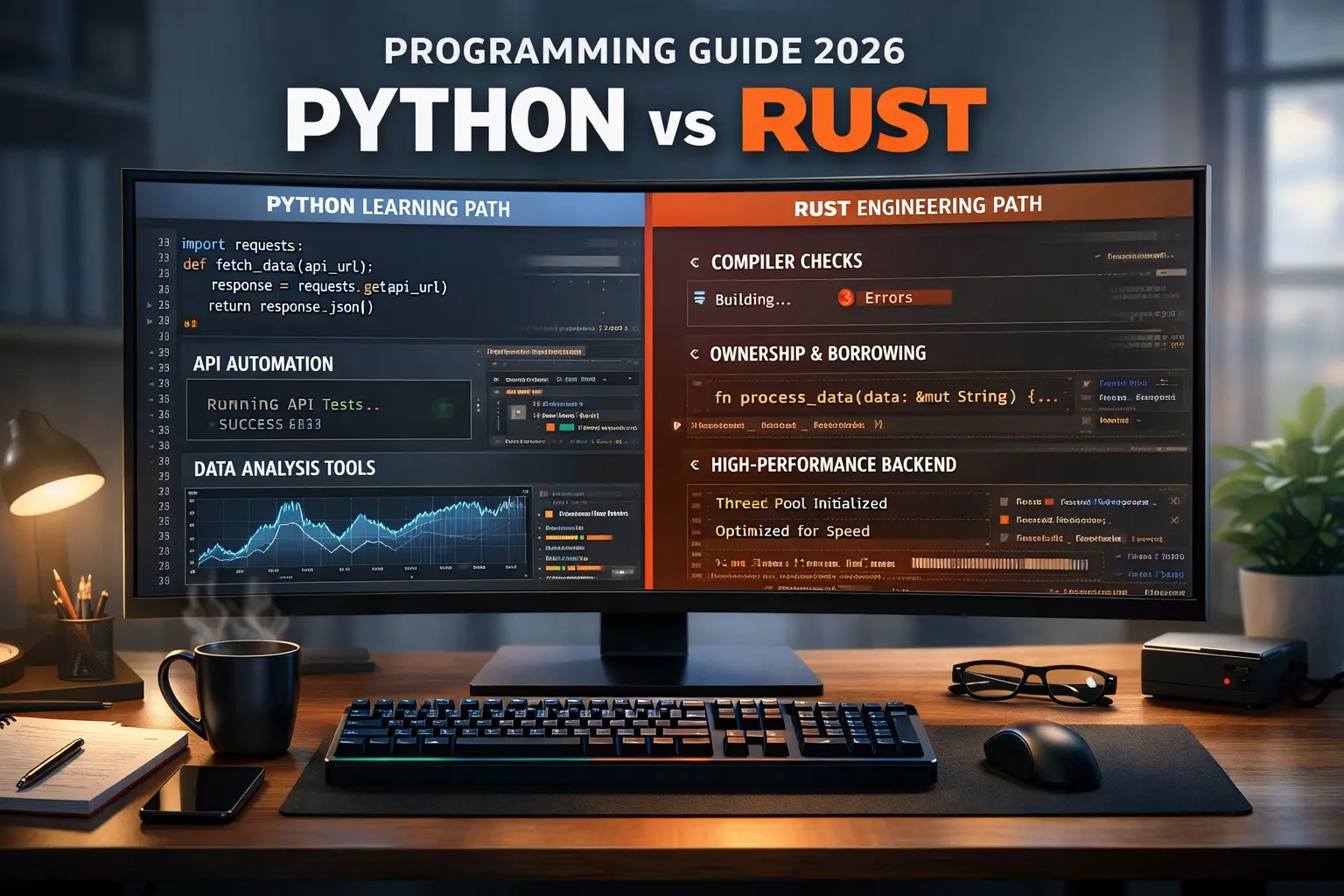
Which programming language should you learn in 2026: a practical Python vs Rust path
A data-backed 2026 guide to choosing your next language. Why Python is still the best first language for most beginners, why Rust is a strong second move for advanced developers, and what trade-offs to expect in real work.
Short version: choose by your current level and your next 12 months
As of March 4, 2026, this is the most practical choice pattern for most people.
What current data says in 2026
The table below combines different signal types: popularity indices, real developer usage, ecosystem depth, and growth momentum.
| Source | What it measures | Python signal | Rust signal | Why this matters |
|---|---|---|---|---|
| TIOBE (Mar 2026) [1] | Broad language visibility index | #1 at 23.88% | Lower rank than Python | Python remains top-of-mind across industries. |
| Stack Overflow Survey 2025 [2] | Languages used by professional developers | 57.9% of pros work with Python | Rust has smaller but focused usage share | Python is still mainstream in day-to-day work. |
| GitHub Octoverse 2025 [3] | Year-over-year growth in GitHub activity | Strong ongoing adoption in data and automation workflows | Rust is the fastest-growing language, +50.3% YoY | Rust momentum is real, especially for advanced teams. |
| PyPI Year in Review 2025 [8] | Python package ecosystem scale | 724,443 projects, up 17% YoY | Not applicable | Python ecosystem breadth lowers beginner friction. |
| Rust Survey 2025 [9] | Active Rust community profile | Not applicable | 9,385 responses, around 30% in first year with Rust | New Rust adoption pipeline is healthy. |
| Rust Survey 2024 [10] | Non-user and user barriers | Not applicable | 31% of non-users cite difficulty as the top blocker | Rust pays off, but onboarding cost is real. |
Why Python is still the best first language for most beginners
Python wins for beginners because the feedback loop is fast, the syntax is readable, and the ecosystem lets you build useful things quickly.
A practical Python-first rule is simple: optimize for shipping your first 3 to 5 real projects, not for theoretical perfection.
Example starter baseline:
from typing import Iterable


def normalize_user_ids(items: Iterable[str]) -> list[int]:
    out: list[int] = []
    for raw in items:
        if raw.strip().isdigit():
            out.append(int(raw))
return outWhat you gain quickly
Why market data still supports Python
Main pitfalls to expect
How to avoid those pitfalls
Start with guardrails from day one: virtual environments, strict linting, type hints, and tests. Treat pip install as software supply chain work, not a casual step. This keeps Python codebases healthy as they grow.
Why Rust is a strong move for experienced developers
Rust is not the easiest first language, but for advanced engineers it can be a major upgrade in reliability, performance, and system-level confidence.
A practical Rust-first component style:
fn parse_port(input: &str) -> Result<u16, String> {
    input
        .trim()
        .parse::<u16>()
        .map_err(|_| format!("invalid port: {input}"))
}What Rust gives you
Rust pushes correctness checks into compile time. Ownership, borrowing, and strict types reduce whole classes of runtime bugs, especially in concurrent and memory-sensitive systems. [12]
Why Rust momentum matters in 2026
Main pitfalls to plan for
How to make Rust adoption work
Do not force a big-bang rewrite. Start where Rust has maximum leverage: performance-critical workers, parsers, infrastructure tools, and reliability-sensitive services. Keep scope narrow, ship one component, then expand.
Choose by profile, not by hype
Use this matrix if you want a concrete decision in under two minutes.
Sequence wins
Python gives breadth, Rust gives depth and differentiation.
A practical decision matrix by experience level and project constraints, not by social media hype.
Section decision-framework screenshotFAQ
For most people, no. Rust can be very rewarding, but Python usually gives a much faster path to first results and confidence. A sequence approach works better for most beginners: Python first, then Rust for deeper systems work.
Yes. Python remains broadly used in production and has one of the largest tool ecosystems. AI helps productivity, but teams still need developers who can design, test, and maintain real systems.
Rust makes the biggest difference when reliability and performance matter at the same time: backend infrastructure, CLI tools, parsers, networking services, and components where memory safety bugs are costly.
Use the first three months to build projects in Python and strengthen core engineering habits. Use the next three months to build one focused Rust component that solves a real performance or reliability problem.
Sources
Official docs, official surveys, and primary ecosystem reports checked on March 4, 2026.
Related Articles
How to Add Mau Saver to a Telegram Group and Save Media in Chat
A practical guide to adding Mau Saver to a Telegram group and downloading videos, audio, and posts directly in the chat.

How to Advertise to an International Telegram Media Audience
A practical guide for advertisers: reach an international Telegram audience through Mau Saver Bot, group placements, pinned posts, and native media integrations.
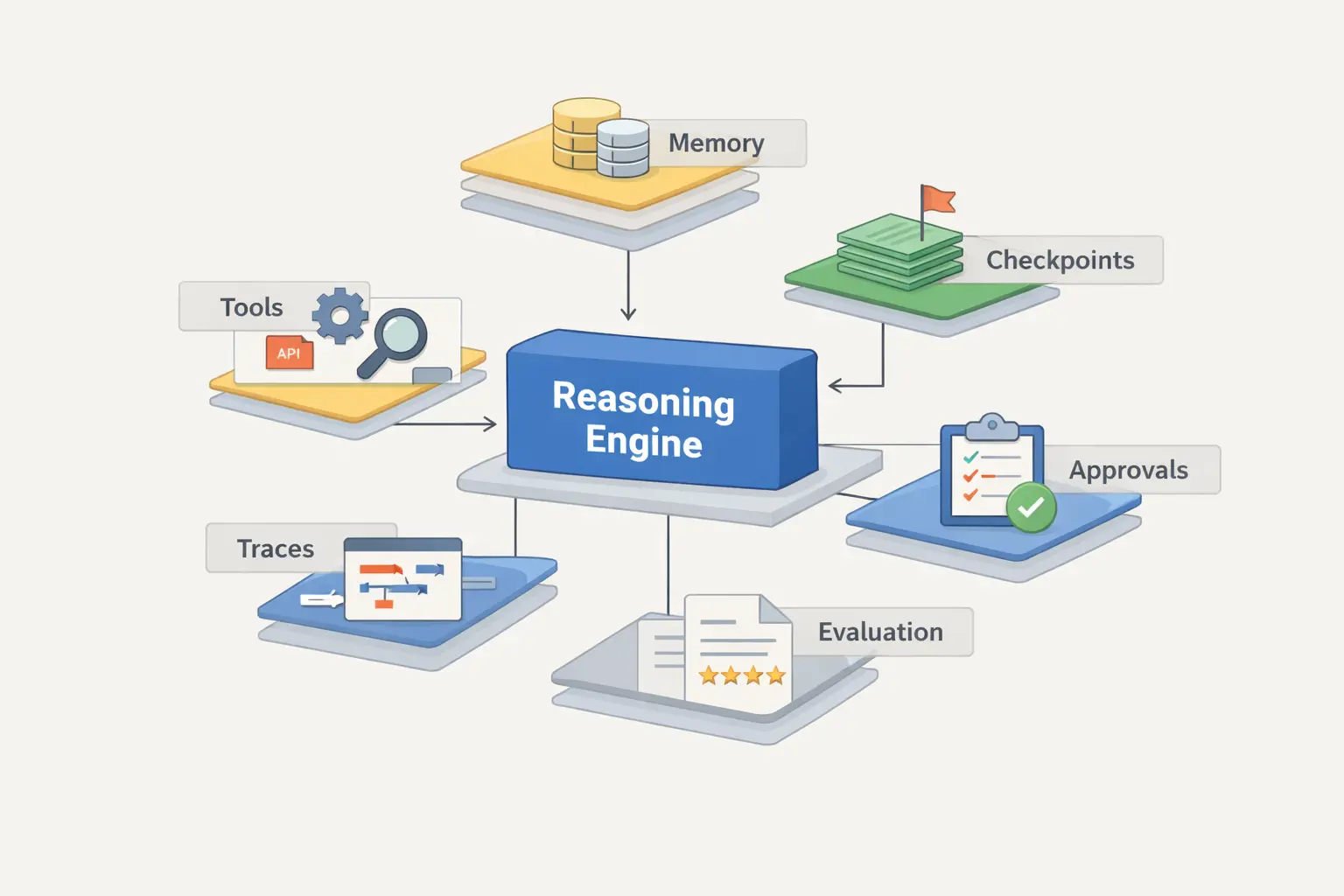
AI Assistant Development Cost in 2026: RAG Chatbots, CRM Integrations, Guardrails, and Support
A practical buyer guide to AI assistant development cost in 2026: prototypes, RAG chatbots, knowledge-base assistants, CRM and website integrations, guardrails, evaluations, monitoring, and support.

AI Can Make More. Not Better: What Game Development Research Actually Says
Generative AI is entering game production, but the evidence is more nuanced than the hype. We examine developer adoption, player reception, quality risks, and a practical production model for using AI without outsourcing taste.