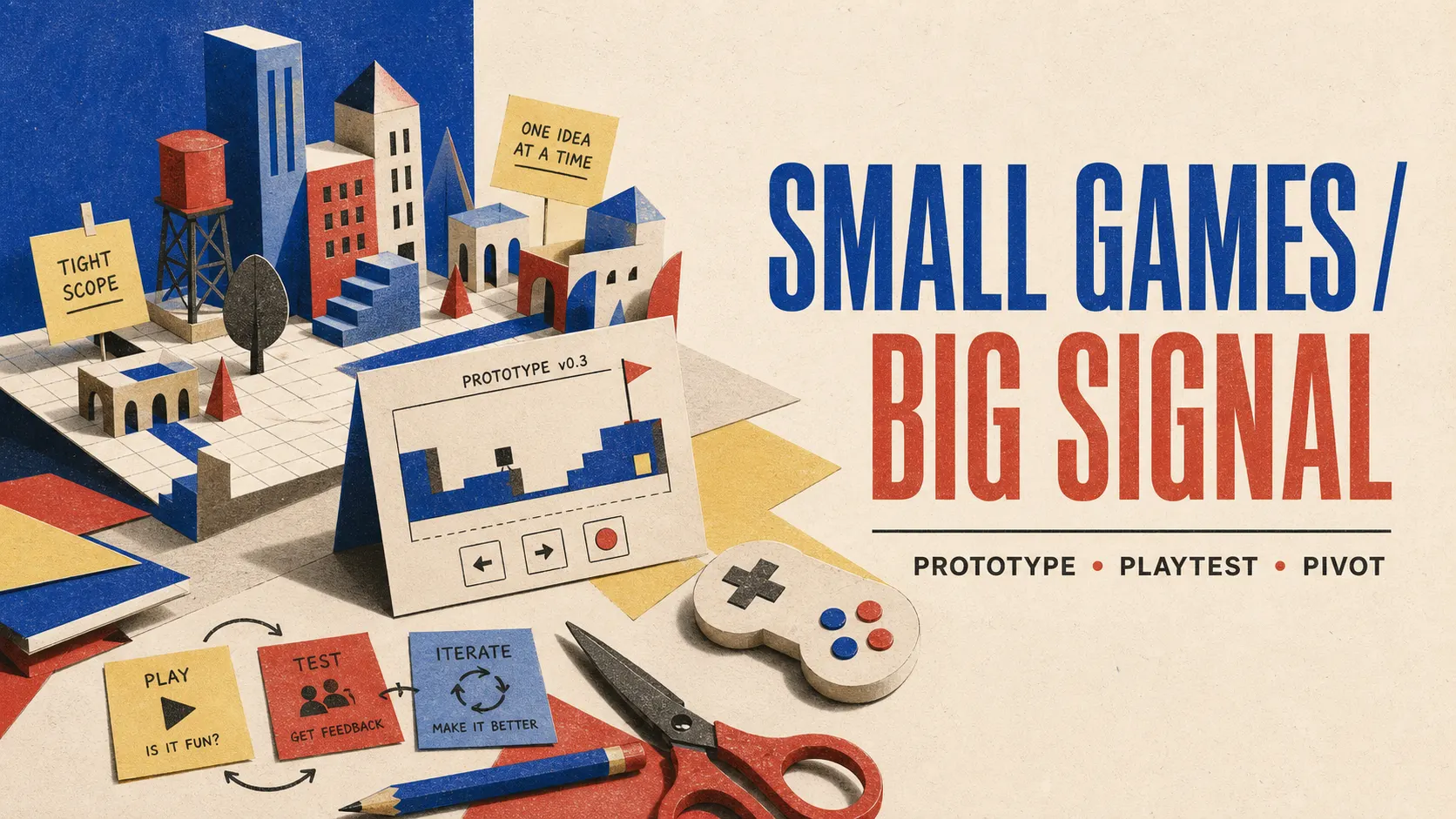
Small Games, Big Signal: Why 2026 Is Rewarding Focused Game Development
The 2026 game development landscape is pushing studios toward smaller scopes, faster prototypes, and clearer player value. Here is what the data means for indie teams and game product strategy.
The strongest production signal in 2026 is not that every game should be smaller. It is that teams are reducing risk by testing a sharper core idea earlier. Unity reports that 52% of surveyed developers prioritize smaller-scale projects as a risk-reduction strategy, while 67% said their prototype phase lasts three months or less. [1]
The market is making focus a competitive advantage
After years of bigger worlds, longer roadmaps, and more live content, the useful question is becoming simpler: what is the smallest version of this game that can create a real player reaction?
Small scope is not the same as small ambition
Scope describes how much a team must build. Ambition describes what the player should feel. A compact game can still have a strong world, a memorable mechanic, or a distinct social promise; it simply refuses to make every supporting system a launch requirement.
The dangerous version of scope is feature counting: fewer maps, fewer weapons, fewer quests. The useful version is promise counting: one strong loop, one clear audience, one reason to return. This distinction changes production conversations. Instead of asking “what can we cut?”, ask “what must be true for the game to be itself?”
That is also why low-fidelity prototypes are more than throwaway demos. They are arguments. A prototype should make one claim visible: this movement feels good, this decision creates tension, this co-op role makes friends talk, or this world makes players curious enough to continue.
A prototype should answer four questions
A fast prototype is not a miniature final game. It is a cheap instrument for reducing uncertainty.
Who is this for?
Name the player in behavioral terms: someone who likes short tactical runs, quiet exploration, chaotic co-op, or mastery through repetition.
What is the first minute?
Test the first interaction, not only the endgame. If the promise is invisible at the start, polish will not rescue onboarding.
What creates the return?
Identify the source of curiosity, mastery, social memory, collection, or surprise. “More content later” is not a retention loop.
What evidence changes the plan?
Set stop, change, and continue conditions before playtesting. Otherwise feedback becomes decoration for a decision already made.
The focused studio still needs a wide operating view
Reducing scope does not remove production complexity. It moves attention toward the few systems that decide whether the game can find and keep its audience.
| Area | Focused approach | Common mistake |
|---|---|---|
| Design | Protect one recognizable player promise | Add features before validating the loop |
| Production | Use short playable milestones | Treat the first playable build as a ceremony |
| Community | Invite the right players early | Wait until launch to learn who cares |
| Technology | Buy or build only what supports the promise | Accumulate infrastructure because it might be useful |
A great small game still has to be findable
Unity’s 2026 report identifies competition, user-acquisition cost, and discoverability as major challenges for mobile developers; it also reports heavy reliance on platform analytics and industry research. [1] The broader lesson applies beyond mobile: distribution is not a final marketing layer. It is feedback about whether the product’s promise is legible to the people it is for.
For a small team, this can be an advantage. A narrow game can speak more clearly than a broad one. Its store page, trailer, community post, and first playable build can all make the same promise. That consistency is a product asset, not merely a copywriting improvement.
The practical minimum is modest: a landing page or store page with a clear hook, a playable slice that demonstrates it, a way to collect structured feedback, and analytics that answer behavior questions rather than inflate dashboards.
What focused teams should not romanticize
Small teams can still overbuild invisible infrastructure. Scope discipline includes tools, backend, content pipelines, and live operations.
Fast prototypes can create false confidence when they skip performance, accessibility, controller support, or the actual target platform.
Community feedback is not a vote. It is evidence that needs interpretation; the loudest request is not always the most important product signal.
A smaller game is not automatically cheaper. A clear promise can demand more iteration because players notice when the central loop is weak.
Summary
The goal is not to make less. The goal is to learn earlier what deserves more.
Sources and further reading
Make the first version answer the right question
The point of a smaller game is not to shrink ambition until nothing can go wrong. It is to move important uncertainty to a moment when the team can still respond. A focused prototype lets the idea earn complexity instead of receiving it by default. That makes scope a creative tool. It protects the mechanic, audience, and feeling that give the game an identity, while leaving enough time to listen, change direction, and finish with care. The strongest small games will be the ones where every part of the experience makes the same promise — clearly, deliberately, and early enough to matter.
Related Articles

How to Add Mau Saver to a Telegram Group and Save Media in Chat
A practical guide to adding Mau Saver to a Telegram group and downloading videos, audio, and posts directly in the chat.

How to Advertise to an International Telegram Media Audience
A practical guide for advertisers: reach an international Telegram audience through Mau Saver Bot, group placements, pinned posts, and native media integrations.
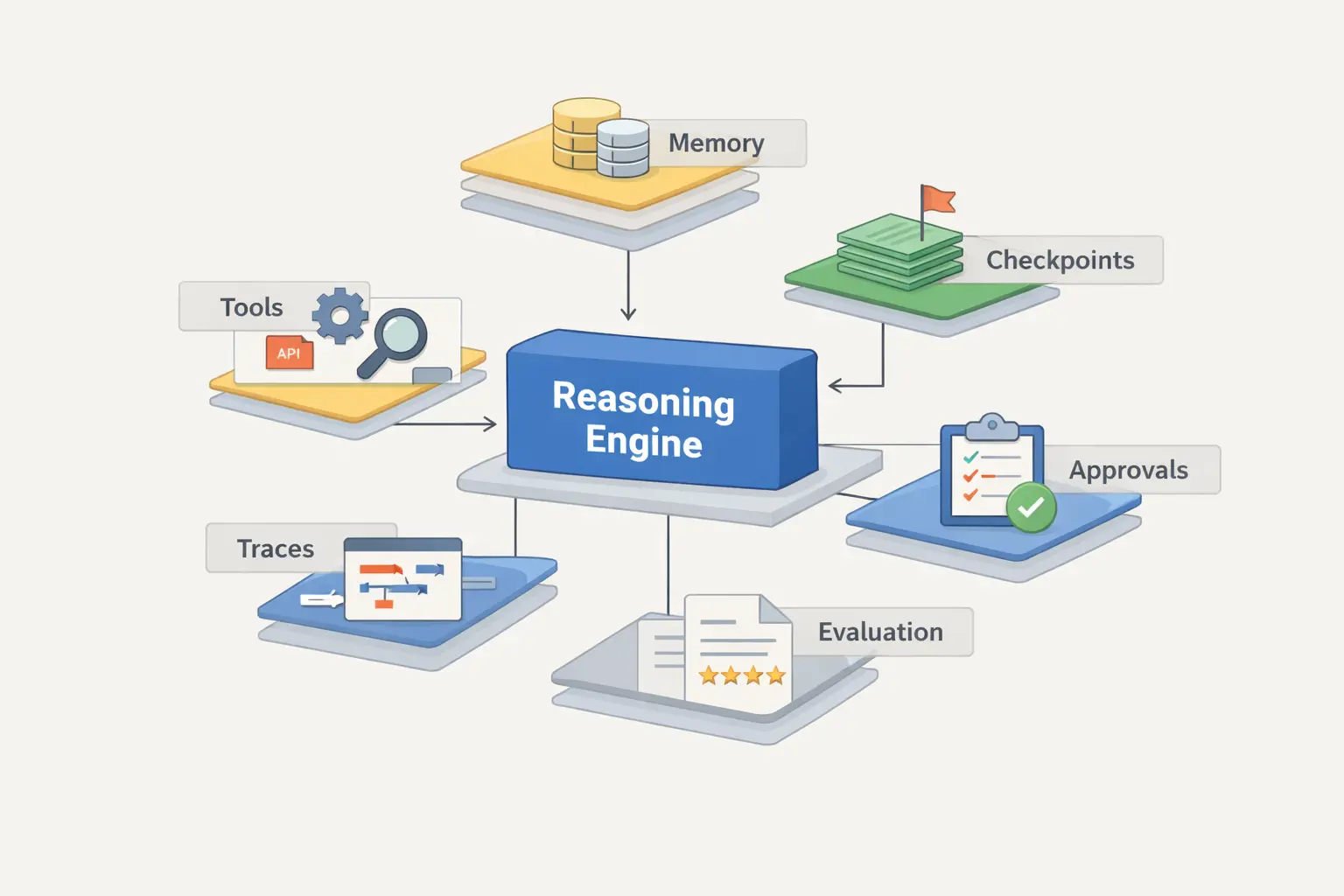
AI Assistant Development Cost in 2026: RAG Chatbots, CRM Integrations, Guardrails, and Support
A practical buyer guide to AI assistant development cost in 2026: prototypes, RAG chatbots, knowledge-base assistants, CRM and website integrations, guardrails, evaluations, monitoring, and support.
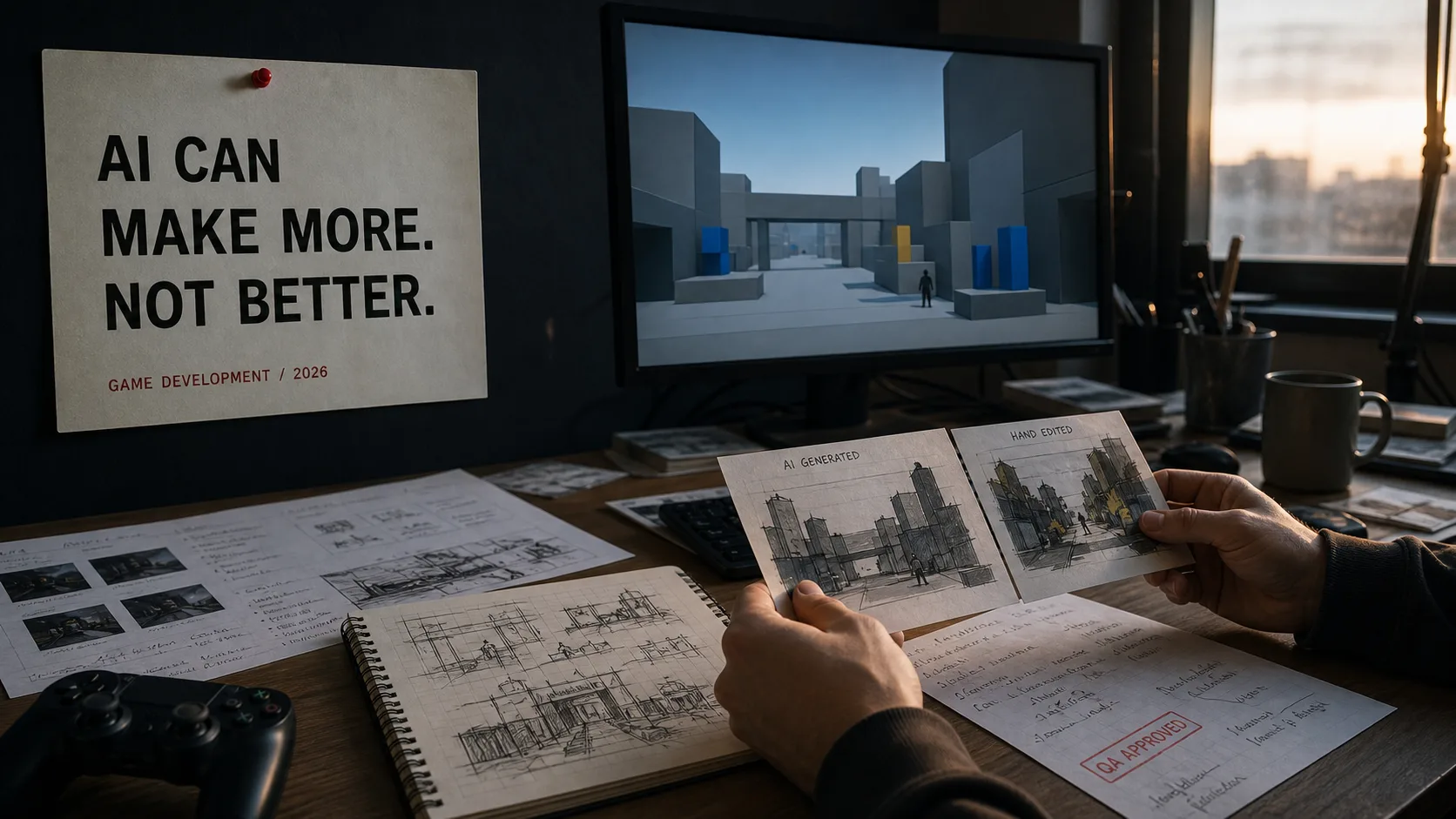
AI Can Make More. Not Better: What Game Development Research Actually Says
Generative AI is entering game production, but the evidence is more nuanced than the hype. We examine developer adoption, player reception, quality risks, and a practical production model for using AI without outsourcing taste.