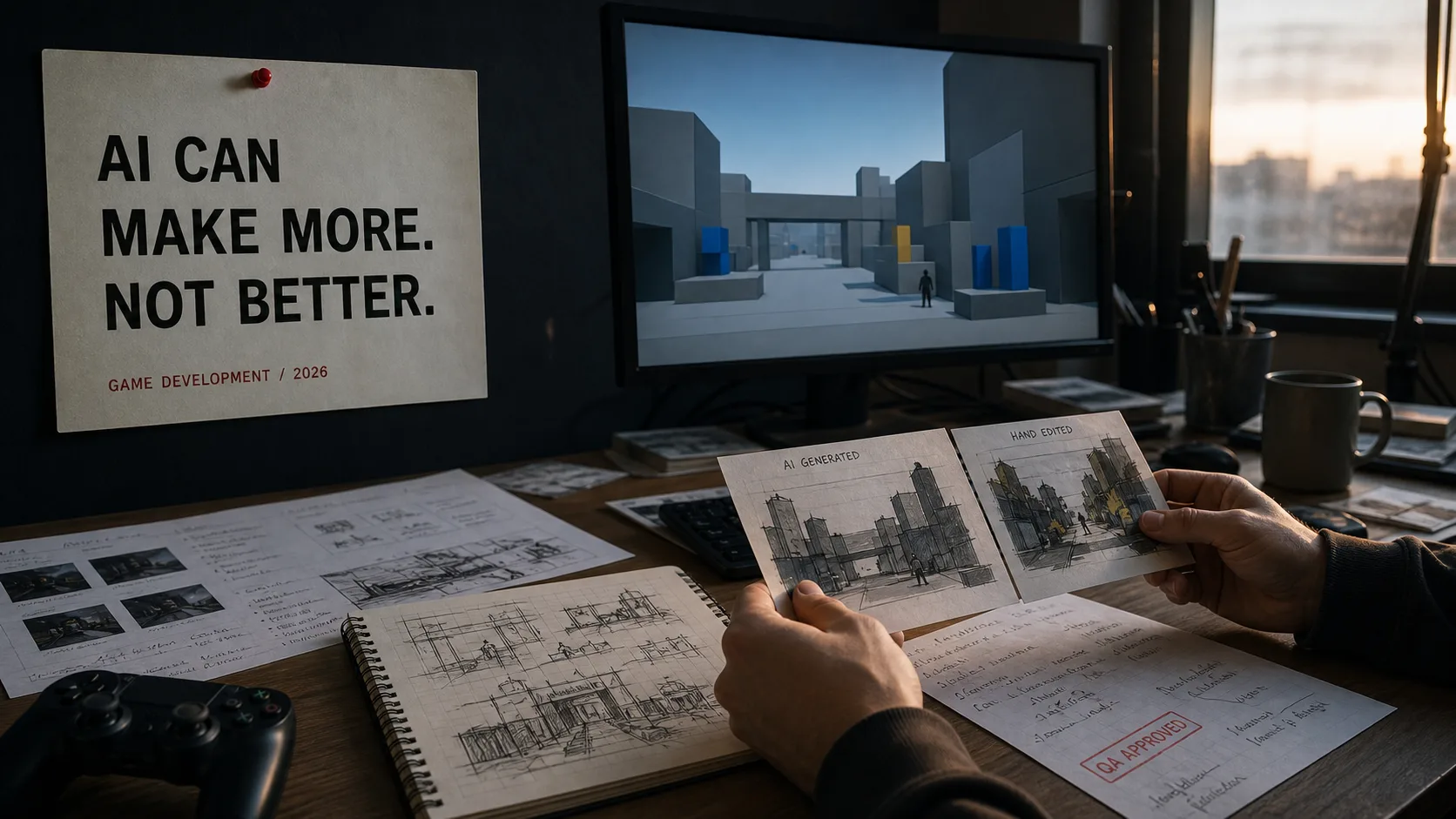
AI Can Make More. Not Better: What Game Development Research Actually Says
Generative AI is entering game production, but the evidence is more nuanced than the hype. We examine developer adoption, player reception, quality risks, and a practical production model for using AI without outsourcing taste.
Current research does not support the simple claim that generative AI makes better games. It supports a narrower conclusion: AI can expand ideation and production capacity, but introduces risks around correctness, coherence, calibration, authorship, and player trust. GDC’s 2026 survey found 36% of game-industry professionals using generative AI, while a 2026 Steam-review study reported lower recommendation rates and more negative sentiment for games disclosing generative AI use than for procedural-content games. [1][2][3]
The adoption story is real — and less dramatic than the pitch
The latest data suggests that AI is becoming ordinary production infrastructure before it becomes an autonomous game designer.
Three research findings worth taking seriously
More variation is not automatically more play
A 2026 study of LLMs embedded in two game projects found potential for more variability and personalization, alongside problems with correctness, difficulty calibration, and structural coherence. Novelty still needs design boundaries. [2]
Players read AI as a production signal
An August 2026 analysis of 508,192 English-language Steam reviews found that games disclosing generative AI received lower recommendation rates and more negative sentiment than games using procedural content generation as the comparison point. The authors interpret this partly as a perception of lower developer investment. [3]
Treat AI as a junior collaborator with infinite confidence
The most useful mental model is not “AI employee” and not “magic autocomplete.” It is a junior collaborator who can produce options quickly, does not know which constraints matter, and will present a wrong answer with the same confidence as a good one.
That changes the production question. Instead of asking whether a model can create a quest, texture, NPC line, or code module, ask what review surface makes the output safe to use. Can a designer compare ten variants in a minute? Can an automated test catch invalid state? Can the team trace which source material entered the prompt? Can the player tell when a generated response is part of the fiction rather than an uncontrolled system behavior?
If the answer is no, the bottleneck has moved from making the thing to verifying it. Speed at the front of the funnel is not progress if it floods the rest of production with ambiguity.
The quality equation
Production value = generation speed × review quality × fit with the game’s design language. If review quality approaches zero, generation speed only creates more work.
Where AI belongs in a serious game pipeline
Use AI where the team can define a boundary, inspect the result, and discard it cheaply.
Explore
Generate concept directions, references, test data, dialogue variants, or prototype scaffolding. Keep the output explicitly disposable.
Constrain
Add the game’s style rules, technical budgets, content taxonomy, accessibility requirements, and failure cases. The prompt is not the design document.
Review
Have the responsible discipline review the result: design, art, narrative, code, legal, or QA. No model output skips ownership.
Test
Run the same playtests, automated checks, performance budgets, localization checks, and safety reviews as human-authored work.
Disclose where it matters
Document provenance internally and communicate player-facing use when it affects trust, monetization, identity, or the perceived authorship of the experience.
The expensive mistakes are mostly organizational
Measuring output volume instead of player value: more dialogue, quests, or assets do not equal a richer game.
Allowing generated content to define canon: a model can produce plausible fragments that quietly contradict the world, economy, or rules.
Skipping provenance: teams need to know what data, model, license, and approval path sit behind a shipped asset.
Introducing an LLM into a live game without a rollback plan: player-facing systems need rate limits, moderation, observability, deterministic fallbacks, and a way to turn the feature off.
Calling a prototype a product: a generated demo can prove that something is possible while saying almost nothing about whether it is maintainable, balanced, or fun.
One question before you add AI
What does the player get that a cheaper, more predictable tool could not give them?
If the answer is only “we can make more of it,” pause. Procedural generation, authored templates, search, simulation, and ordinary automation may deliver the same player value with better control. Use generative AI when it creates a meaningful improvement in exploration, personalization, accessibility, or iteration — and when the team is willing to own the new quality and trust surface. [3][4]
Sources and further reading
Ship the judgment, not just the generation
The evidence points to a useful but unglamorous conclusion: generative AI is most valuable when it removes friction from exploration, not when it pretends to replace judgment. It can widen the first draft, but it does not define the final experience. For a game team, the real advantage is not the number of assets a model can produce. It is the number of ideas the team can test without lowering its standards. Authorship, taste, balance, and player trust remain explicit responsibilities. Use AI to make the next question cheaper to ask, then let people and tests decide whether the answer is worth shipping.
Related Articles

How to Add Mau Saver to a Telegram Group and Save Media in Chat
A practical guide to adding Mau Saver to a Telegram group and downloading videos, audio, and posts directly in the chat.

How to Advertise to an International Telegram Media Audience
A practical guide for advertisers: reach an international Telegram audience through Mau Saver Bot, group placements, pinned posts, and native media integrations.
AI Assistant Development Cost in 2026: RAG Chatbots, CRM Integrations, Guardrails, and Support
A practical buyer guide to AI assistant development cost in 2026: prototypes, RAG chatbots, knowledge-base assistants, CRM and website integrations, guardrails, evaluations, monitoring, and support.

AI coding agents on a team: where speed ends and control begins
How to give an AI coding agent useful access to a repository, issue tracker, and environment without making CI, secrets, and production depend on a prompt.