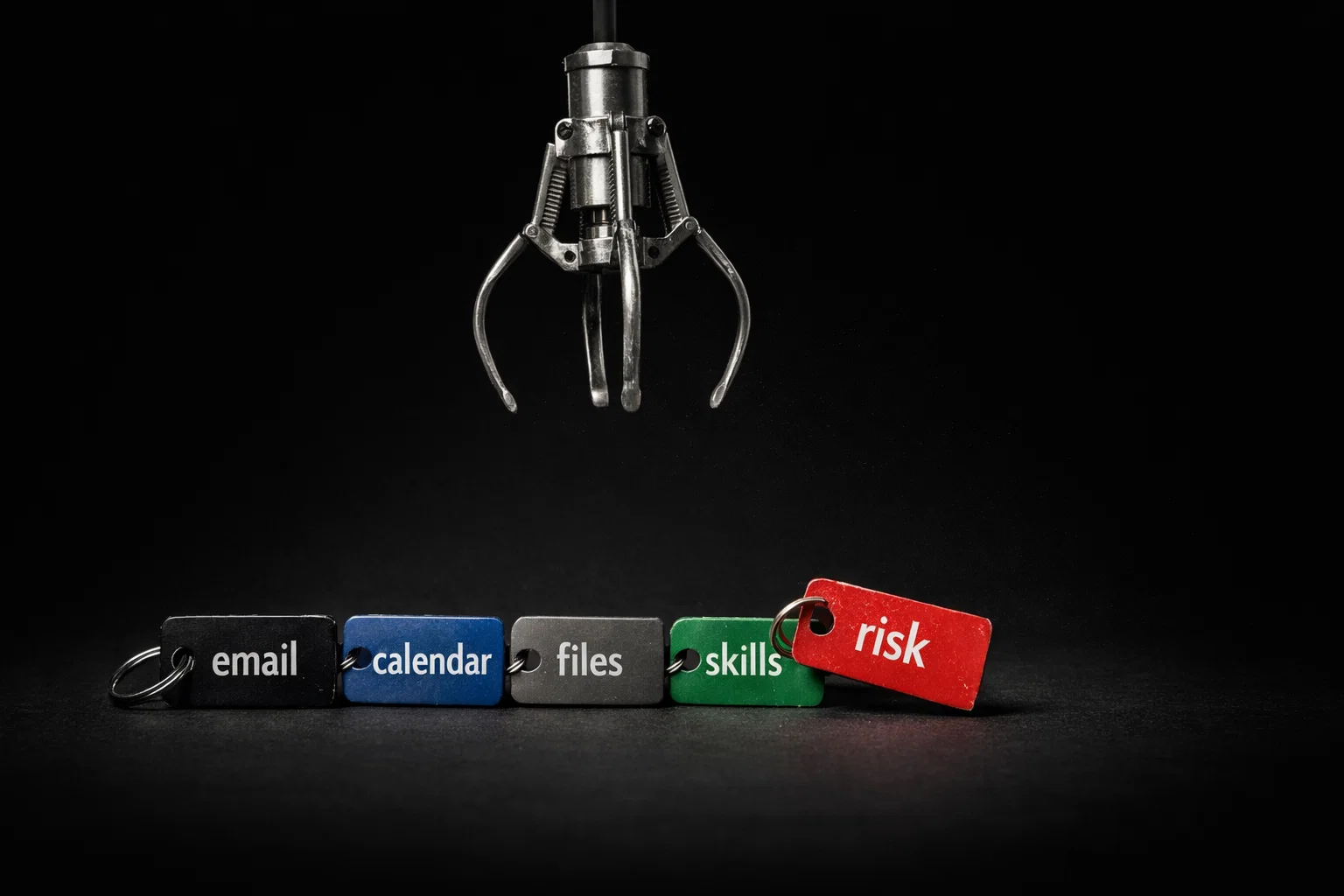
OpenClaw: a personal AI agent in your chats — and why security is half the product
OpenClaw is an open-source personal AI agent platform you run on your own machine and use from WhatsApp/Telegram/Slack/Discord. We break down the Gateway control plane, channels and Skills/ClawHub, show practical “solved” use cases (Inbox Zero, release coordinator, content scout), and compare the crowded landscape of alternatives (LangGraph, AutoGen, CrewAI, OpenHands, n8n, Dify, Flowise, AutoGPT, Open Interpreter) with a hardening checklist.
What you’ll take away
Not a hype recap, but a working framework: what OpenClaw is, where it shines, where it bites, and how to compare it to the “whole bunch” of alternatives.
How OpenClaw is structured: channels → Gateway (control plane) → sessions/tools/agents. [2]
Skills and ClawHub: why extensions become a supply-chain surface with your agent’s privileges. [2][7][8]
3 practical solved use cases: Inbox Zero, release coordinator, content scout for blog/marketing. [2][1]
Hardening checklist: sandboxing, DM pairing, allowlists, isolation, and credential discipline. [2][8][9]
Comparison with alternatives: LangGraph/AutoGen/CrewAI (frameworks), OpenHands (coding agent), n8n/Dify/Flowise (automation/orchestration), AutoGPT (continuous agents), Open Interpreter (local code + computer control). [11][12][13][14][18][16][17][19][15]
Name collision: “OpenClaw” is also used by an open-source reimplementation of the Captain Claw (1997) game — different product. [20]
OpenClaw, in plain terms
OpenClaw is an open-source personal AI agent platform you run on your own devices (laptop/homelab/VPS) and connect to the channels where you already live: WhatsApp, Telegram, Slack, Discord, and more. The headline promise is “Your assistant. Your machine. Your rules.” [1]
In practice that means two things:
1) the agent is closer to your data and tools (files, email, calendar, tasks),
2) the security responsibility is closer to you too (isolation, tokens, access rules, skills control). [2][8]
The README offers a useful mental model: “Gateway is the control plane; the product is the assistant.” Think of it like a runtime with interfaces (channels) and capabilities (skills), not a single chatbot. [2]
How it works: channels → Gateway (control plane) → agents/sessions/tools
OpenClaw tries to make “an agent in chat” feel like a real system product: a control plane, sessions, policies, tools, and a UI/CLI surface.
A simple diagram (adapted from the README) helps teams align quickly: [2]
WhatsApp / Telegram / Slack / Discord / …
           │
           ▼
┌───────────────────────────────┐
│            Gateway            │
│         (control plane)       │
│     ws://127.0.0.1:18789      │
└──────────────┬────────────────┘
               │
               ├─ CLI (openclaw …)
               ├─ Web UI
               └─ Agent runtime (tools / sessions)
Architecture signal: if you need a personal agent in your chats, OpenClaw fits. If you need to build your own agent graphs and orchestration, look at frameworks like LangGraph/AutoGen/CrewAI. Different category. [11][12][13]
Gateway
A single control plane for sessions, channels, events, tools, and UI/CLI access. [2]
Gateway Control Panel UI: where channels/integrations are managed and the agent is operated. Source: Bitsight. [10]
Section architecture screenshotQuick start: what a “grown-up” install looks like
The README’s recommended path is the onboarding wizard. Minimal flow: install CLI → run openclaw onboard → start the gateway → send a test message or talk to the agent. [2]
npm install -g openclaw@latest

openclaw onboard --install-daemon

openclaw gateway --port 18789 --verbose

openclaw message send --to +1234567890 --message "Hello from OpenClaw"

openclaw agent --message "Ship checklist" --thinking high
Then reality kicks in: access policies (DM pairing, sandbox for group sessions) and secret/token hygiene. OpenClaw even suggests running openclaw doctor to surface risky configurations. [2]
3 solved use cases: how we’d implement this at PAS7 Studio
Below are three patterns that deliver value in the first week. They don’t require “AGI”, but they do require constraints and operational discipline.
Use case 1 — Inbox Zero without “autonomous sending”
Goal: let the agent read/classify/draft, but make final sending explicitly human-approved.
Rule #1: the agent never sends an email without an explicit approval (human-in-the-loop).
Rule #2: all inbound content is untrusted input (email is a perfect prompt-injection carrier). [8][9]
Flow: triage → short summaries → 2–3 reply drafts → context questions → approve.
Artifact: a daily “Inbox digest” to Telegram/Slack plus auto-labeling/rules.
Credentials: use least-privilege OAuth/tokens and a separate pilot mailbox for rollout. [8]
Team note: Microsoft explicitly recommends isolation (VM/dedicated device) and treating this as untrusted execution with persistent credentials. [8]
Use case 2 — Release coordinator in chat: checklists, brief, post-release report
Goal: reduce human error in releases. The agent acts as an operator: gathers context, prompts steps, drafts summaries, but critical actions require approval.
Input: the team asks “Ship checklist” in a release channel (the README uses this example), and the agent generates a stack-aware checklist. [2]
Pulls artifacts: changelog links, migrations, feature flags, rollback plan.
Gates: anything that can change infra/prod runs only after explicit approval.
Output: a post-release report: what shipped, what rolled back, action items.
Hardening: for groups/channels, enable sandboxing for non-main sessions in Docker, as described in the README. [2]
Use case 3 — Content scout: sources → draft → PR-ready post
Goal: find a technical story/trend → collect sources → outline in your format → produce a PR for review.
Strict policy: the agent doesn’t invent facts; it works from sources and adds citations for each key claim.
Flow: (1) link gathering, (2) thesis extraction, (3) outline, (4) draft, (5) real images from sources, (6) PR.
Security: any skills that fetch external content open a path for indirect prompt injection (content can carry instructions). Microsoft and Snyk highlight this risk class. [7][8]
Practical pattern: isolate content workflows in a separate workspace/agent with no access to production secrets.
OpenClaw security: the real world and the minimum safe posture
Agents combine untrusted input + ability to act + long-lived tokens. That shifts the security boundary: you plan containment and recovery, not just prevention. [8]
What to do (minimum viable hardening):
- Isolation: Microsoft recommends evaluating OpenClaw only in an isolated environment (VM/dedicated device), with separate non-privileged accounts and no sensitive data. [8]
- DM policies: the README describes DM pairing so unknown senders can’t inject commands without pairing. This is non-negotiable. [2]
- Group sandboxing: agents.defaults.sandbox.mode: "non-main" runs non-main sessions inside Docker sandboxes, reducing blast radius. [2]
- Skills: treat as privileged code. The “install by default” mindset is toxic here. Snyk shows a meaningful portion of skills with critical issues and hostile patterns in the wild. [7]
- Defense in depth: even marketplace scanning is a layer, not a guarantee. OpenClaw explicitly states that. [3]
Intent-level config snippet (illustrative): [2]
agents:
  defaults:
    sandbox:
mode: "non-main"About scanning skills: why it matters, and why it’s not enough
OpenClaw announced a VirusTotal integration for scanning skills in ClawHub: deterministic packaging → hashing → VT lookup/upload → code insight → labels/blocking → daily re-scans. It’s a solid defense-in-depth layer. [3]
OpenClaw alternatives: there are many, but they’re different categories
To compare fairly, classify alternatives by what you’re trying to build:
1) Personal self-hosted agent in chat (OpenClaw’s category)
2) Frameworks for building agent systems (you build the runtime/graphs)
- LangGraph: orchestration for stateful, long-running agents. [11]
- AutoGen: multi-agent collaboration framework. [12]
- CrewAI: role-based multi-agent automation framework. [13]
3) Coding agents (repos, tests, PRs)
- OpenHands: a platform for cloud coding agents. [14]
4) Automation/orchestration with agents (low-code/no-code)
- n8n AI Agent node: an agent as a workflow node with tools. [18]
- Dify: an open platform for agentic workflows + RAG + ops. [16]
- Flowise: a visual builder for agents and chains. [17]
5) Local code execution / computer control
- Open Interpreter: lets an LLM run code locally (shell/python/js) to complete tasks. [15]
6) Continuous agent platforms
- AutoGPT: a platform for building and running continuous agents. [19]
A practical decision map:
Need a personal agent in WhatsApp/Telegram → OpenClaw.
Need graph orchestration + checkpointing + HITL → LangGraph.
Need multi-agent roles & collaboration → AutoGen/CrewAI.
Need an agent that opens PRs and runs tests → OpenHands.
Need workflow automation with lots of integrations → n8n/Dify/Flowise.
Need local execution / computer control → Open Interpreter.Note: “OpenClaw” is also used for a Captain Claw (1997) game reimplementation
Search results may also show OpenClaw as an open-source reimplementation of the Captain Claw (1997) platformer. That’s a different C++ game product, unrelated to the AI agent platform. [20]
FAQ
Closer to a platform: channels (messengers), Gateway as a control plane, sessions/tools, and skills as extensions. The README frames it as: Gateway is the control plane; the product is the assistant. [2]
Microsoft advises the opposite: treat it as untrusted execution with persistent credentials and evaluate only in isolation (VM/dedicated device), with separate non-privileged accounts and no sensitive data. [8]
It’s a useful defense-in-depth layer, but not a guarantee. The official post emphasizes that scanning won’t catch everything and prompt injection can bypass signatures. [3]
Treat skills as privileged code: allowlist, review, least privilege, isolation, and separate workspaces without production secrets. Snyk shows the ecosystem is already under real-world supply chain pressure. [7][8]
Compare against coding-agent systems like OpenHands. OpenClaw is primarily a personal agent in chats with integrations; that’s a different category. [14]
Sources
We include only sources that directly support the claims and examples in this article. Images used in the post are real, taken from these primary sources (then saved locally as .webp for performance).
Want to ship an agent without shipping unnecessary risk?
OpenClaw offers a compelling UX: an agent in your chats that can take actions. But real production value appears only when security is designed into the product: isolation, least privilege, access policies, skills control, monitoring, and a recovery plan. PAS7 Studio can help: a fast risk audit, a baseline hardening profile, and 2–3 production-ready workflows (inbox/release/content) with human approval and a controlled blast radius.
Related Articles
How to Add Mau Saver to a Telegram Group and Save Media in Chat
A practical guide to adding Mau Saver to a Telegram group and downloading videos, audio, and posts directly in the chat.
How to Advertise to an International Telegram Media Audience
A practical guide for advertisers: reach an international Telegram audience through Mau Saver Bot, group placements, pinned posts, and native media integrations.
AI Assistant Development Cost in 2026: RAG Chatbots, CRM Integrations, Guardrails, and Support
A practical buyer guide to AI assistant development cost in 2026: prototypes, RAG chatbots, knowledge-base assistants, CRM and website integrations, guardrails, evaluations, monitoring, and support.

AI Can Make More. Not Better: What Game Development Research Actually Says
Generative AI is entering game production, but the evidence is more nuanced than the hype. We examine developer adoption, player reception, quality risks, and a practical production model for using AI without outsourcing taste.