How powerful is the new GPT-5.4: the real upgrade, explained with official data
A practical breakdown of GPT-5.4 based on official OpenAI sources: the new features, the most important benchmark gains, pricing and context changes, and how GPT-5.4 compares with GPT-5.3, GPT-5.2, and GPT-5.1.
Short version: GPT-5.4 is the first GPT-5 model that feels like one complete professional stack
As of March 5, 2026, the official OpenAI picture is unusually clear.
GPT-5.4 is OpenAI's most capable and efficient frontier model for professional work, and its biggest upgrade is composition: reasoning, coding, computer use, tool use, and long-horizon workflows now sit in one mainline model. [1][2]
The most visible new capabilities are upfront planning in ChatGPT, native computer use, tool search, 1.05M context in the API, full-fidelity original image detail, and higher factuality than GPT-5.2. [1][2][3][4]
The cleanest benchmark story is this: GPT-5.4 beats GPT-5.2 on GDPval, SWE-Bench Pro, OSWorld-Verified, Toolathlon, and BrowseComp, while also inheriting frontier coding ability from GPT-5.3-Codex. [1]
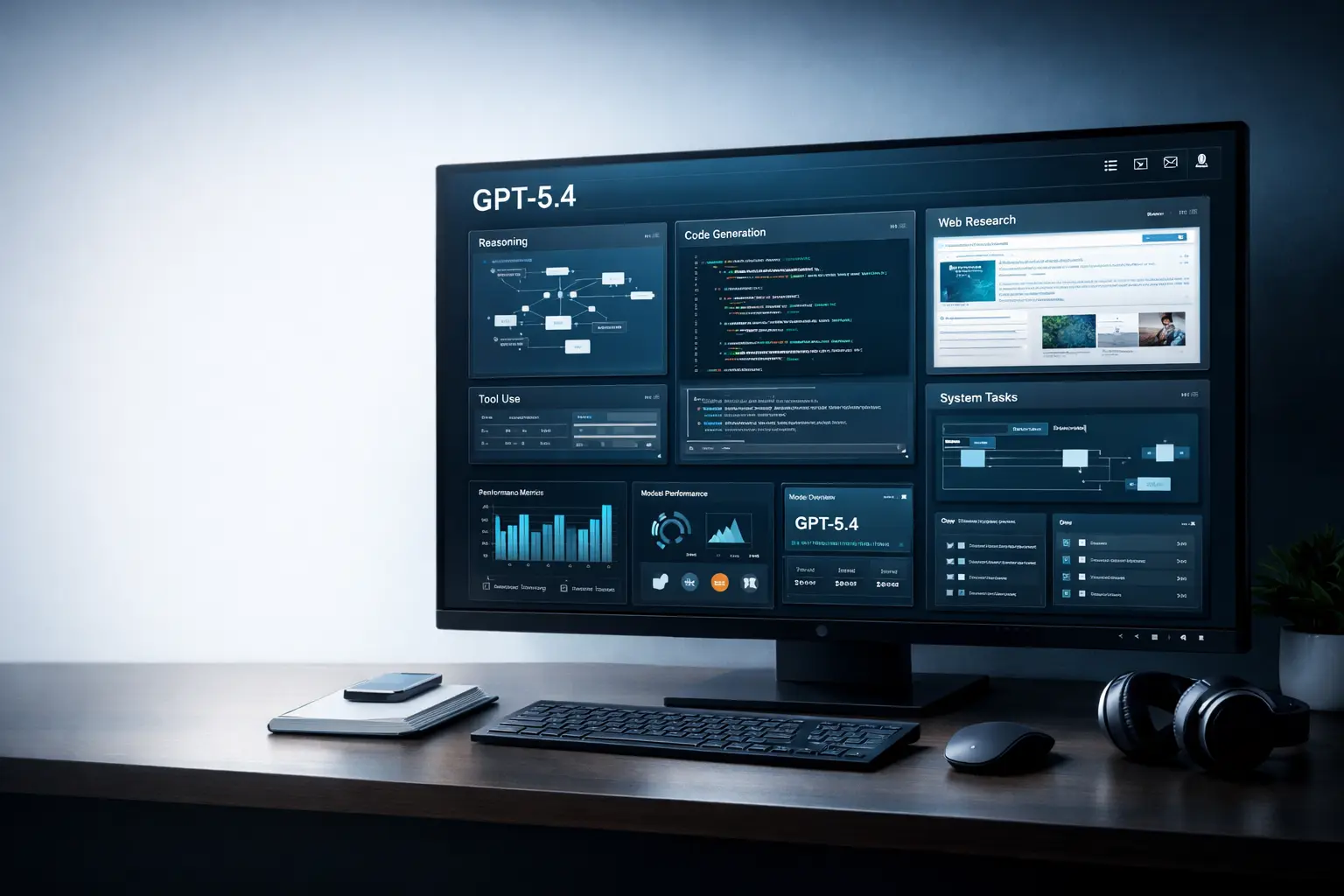
A compact dashboard view of the GPT-5.4 release: the feature stack, the benchmark shift, and the 5.1 to 5.4 version ladder in one frame.
Section overview screenshotThe new features and why they matter in real work
Below are the changes that actually alter workflow, not just model branding.
1. Upfront planning in ChatGPT
GPT-5.4 Thinking can show an upfront plan before finishing a long answer, which makes mid-course correction easier. That matters because it reduces wasted turns on complex work where the first plan is often not the final plan. OpenAI also says GPT-5.4 improves deep web research, especially for specific queries and longer thinking chains. [1]
2. Native computer use in a general-purpose model
GPT-5.4 is the first general-purpose OpenAI model with native state-of-the-art computer-use capability. This is a bigger jump than it sounds. It means the mainline model is no longer just a reasoner that can call tools. It is also positioned to operate across websites and software environments directly. [1][4]
3. 1.05M context window in the API
4. Tool search for large tool ecosystems
GPT-5.4 introduces tool search in the API. Instead of stuffing every tool definition into the prompt up front, the model can discover tool definitions when needed. OpenAI says that on 250 MCP Atlas tasks with 36 MCP servers enabled, tool search cut total token usage by 47% while keeping the same accuracy. [1]
5. Better high-resolution vision
GPT-5.4 adds an original image detail mode for full-fidelity perception up to 10.24M pixels or a 6000-pixel max dimension. The high detail level also increases to 2.56M pixels or a 2048-pixel maximum dimension. This matters for UI screenshots, dense documents, diagrams, and computer-use accuracy. [1]
6. More factual answers on real error reports
OpenAI says GPT-5.4 is its most factual model yet on a set of de-identified prompts where users had flagged factual errors. Relative to GPT-5.2, GPT-5.4's individual claims were 33% less likely to be false, and full responses were 18% less likely to contain any errors. [1]
Where GPT-5.4 actually moved the bar
The strongest part of the GPT-5.4 launch is that OpenAI did not hide behind one eval. The official release page compares GPT-5.4 against GPT-5.3-Codex and GPT-5.2 across professional work, coding, computer use, and tool use. [1]
| Eval | GPT-5.4 | GPT-5.3-Codex | GPT-5.2 | What the jump means |
|---|---|---|---|---|
| GDPval | 83.0% | 70.9% | 70.9% | Large jump in well-specified professional knowledge work |
| SWE-Bench Pro (Public) | 57.7% | 56.8% | 55.6% | Coding gain is real, but not a huge blowout |
| OSWorld-Verified | 75.0% | 74.0% | 47.3% | Massive jump in computer use over GPT-5.2 |
| Toolathlon | 54.6% | 51.9% | 46.3% | Better multi-step tool calling and orchestration |
| BrowseComp | 82.7% | 77.3% | 65.8% | Stronger persistent web research and search behavior |
The headline is not that GPT-5.4 crushes GPT-5.3-Codex everywhere. It does not. The real story is that GPT-5.4 gets close to or ahead of the specialized coding model while being much broader. That is why the release matters. [1]
A few especially important official details are easy to miss. GPT-5.4 reaches 75.0% on OSWorld-Verified, which OpenAI says is above human performance at 72.4%. It also lifts BrowseComp by 17 percentage points over GPT-5.2, and OpenAI positions it as the new state of the art for multi-step tool use. [1]
Official benchmark ladder from the GPT-5.4 launch, collapsed into the metrics that matter most for real work. [1]
Section benchmarks screenshotHow GPT-5.4 compares with GPT-5.3, GPT-5.2, and GPT-5.1
This is the section where precision matters most. OpenAI's public evidence is not symmetric across all GPT-5 releases, so the fair comparison must separate general-purpose releases from Codex-specialized releases.
| Version | Official role in lineup | Context | Max output | Price input / output | Most important difference from 5.4 |
|---|---|---|---|---|---|
| GPT-5.4 | Current frontier model for professional work | 1.05M | 128k | $2.50 / $15 | Adds native computer use, tool search, and stronger factuality on top of frontier coding [1][2] |
| GPT-5.3 Chat | ChatGPT's GPT-5.3 Instant snapshot | 128k | 16,384 | $1.75 / $14 | Useful for testing latest chat behavior, but not the main benchmark reference for coding or agents [6] |
| GPT-5.3-Codex | Most capable agentic coding model to date | 400k | 128k | $1.75 / $14 | Still has the clearest specialized coding profile and stronger public Terminal-Bench result than 5.4 [5][9] |
| GPT-5.2 | Previous frontier model for professional work | 400k | 128k | $1.75 / $14 | Strong long-context and knowledge-work model, but clearly behind 5.4 on computer use, tool use, and factuality [1][7] |
| GPT-5.1 | Flagship model for coding and agentic tasks | 400k | 128k | $1.25 / $10 | Cheaper, still strong, but from an earlier tooling generation before xhigh reasoning, tool search, and 1.05M context [8][10] |
The cleanest way to think about the version ladder is this.
GPT-5.4 vs GPT-5.3
Compared with GPT-5.3 Chat, GPT-5.4 is a much more serious professional model. It has far larger context, much larger max output, explicit reasoning support, and a much richer official benchmark story. Compared with GPT-5.3-Codex, GPT-5.4 is broader and more balanced, but GPT-5.3-Codex still wins on the official Terminal-Bench 2.0 number at 77.3% versus 75.1%. [1][5][6]
GPT-5.4 vs GPT-5.2
This is the most direct official comparison and also the strongest one. GPT-5.4 raises GDPval from 70.9% to 83.0%, SWE-Bench Pro from 55.6% to 57.7%, OSWorld-Verified from 47.3% to 75.0%, Toolathlon from 46.3% to 54.6%, and BrowseComp from 65.8% to 82.7%. The trade-off is price: GPT-5.4 costs more per token than GPT-5.2. [1][2][7]
GPT-5.4 vs GPT-5.1
The comparison with GPT-5.1 is partly generational and partly tooling-based. GPT-5.1 introduced adaptive reasoning behavior for developers and new tools like apply_patch and shell, while OpenAI's developer partners highlighted better diff editing and responsiveness. GPT-5.4 moves beyond that stage into a broader professional stack with 1.05M context, xhigh reasoning, native computer use, tool search, and stronger cross-domain benchmark results. The cost also goes up materially, from $1.25/$10 to $2.50/$15. [2][8][10]
What GPT-5.4 is best at, and where the older models still make sense
The upgrade is real, but there are still cases where an older model line is the more rational choice.
Where GPT-5.4 is the clear winner
If your work combines reasoning, coding, web research, documents, spreadsheets, presentations, and tool-heavy agent loops, GPT-5.4 is the cleanest official recommendation. It is the first GPT-5 release where OpenAI's own documentation and benchmarks point in one direction without much ambiguity. [1][2]
Where GPT-5.3-Codex still matters
Where GPT-5.2 still makes sense
Where GPT-5.1 still makes sense
FAQ
It is both, and that is the point of the release. GPT-5.4 inherits frontier coding ability from GPT-5.3-Codex, but OpenAI positions it as a broader professional model for documents, spreadsheets, presentations, web research, tool use, and computer use.
Not cleanly. GPT-5.4 is the more complete mainline model, but GPT-5.3-Codex still has the stronger official Terminal-Bench 2.0 result and remains highly relevant for terminal-first coding workflows.
If your workload benefits from larger context, stronger computer use, tool search, and lower error rates, the answer is often yes. If your work is mostly standard analysis or coding without those requirements, GPT-5.2 can still be a strong value choice.
Because OpenAI's deepest official benchmark data for the 5.3 generation is published on GPT-5.3-Codex. GPT-5.3 Chat is documented mainly as a ChatGPT snapshot model, while GPT-5.3-Codex has the stronger public benchmark surface.
Sources
Only official OpenAI sources checked on March 5, 2026.
Related Articles

How to Add Mau Saver to a Telegram Group and Save Media in Chat
A practical guide to adding Mau Saver to a Telegram group and downloading videos, audio, and posts directly in the chat.

How to Advertise to an International Telegram Media Audience
A practical guide for advertisers: reach an international Telegram audience through Mau Saver Bot, group placements, pinned posts, and native media integrations.
AI Assistant Development Cost in 2026: RAG Chatbots, CRM Integrations, Guardrails, and Support
A practical buyer guide to AI assistant development cost in 2026: prototypes, RAG chatbots, knowledge-base assistants, CRM and website integrations, guardrails, evaluations, monitoring, and support.

AI Can Make More. Not Better: What Game Development Research Actually Says
Generative AI is entering game production, but the evidence is more nuanced than the hype. We examine developer adoption, player reception, quality risks, and a practical production model for using AI without outsourcing taste.