GEO vs SEO vs AEO: What Is the Difference in 2026?
GEO vs SEO vs AEO explained without the marketing fog. Learn what each optimization targets, how they overlap, what Google officially recommends, and how to build one practical search visibility strategy.
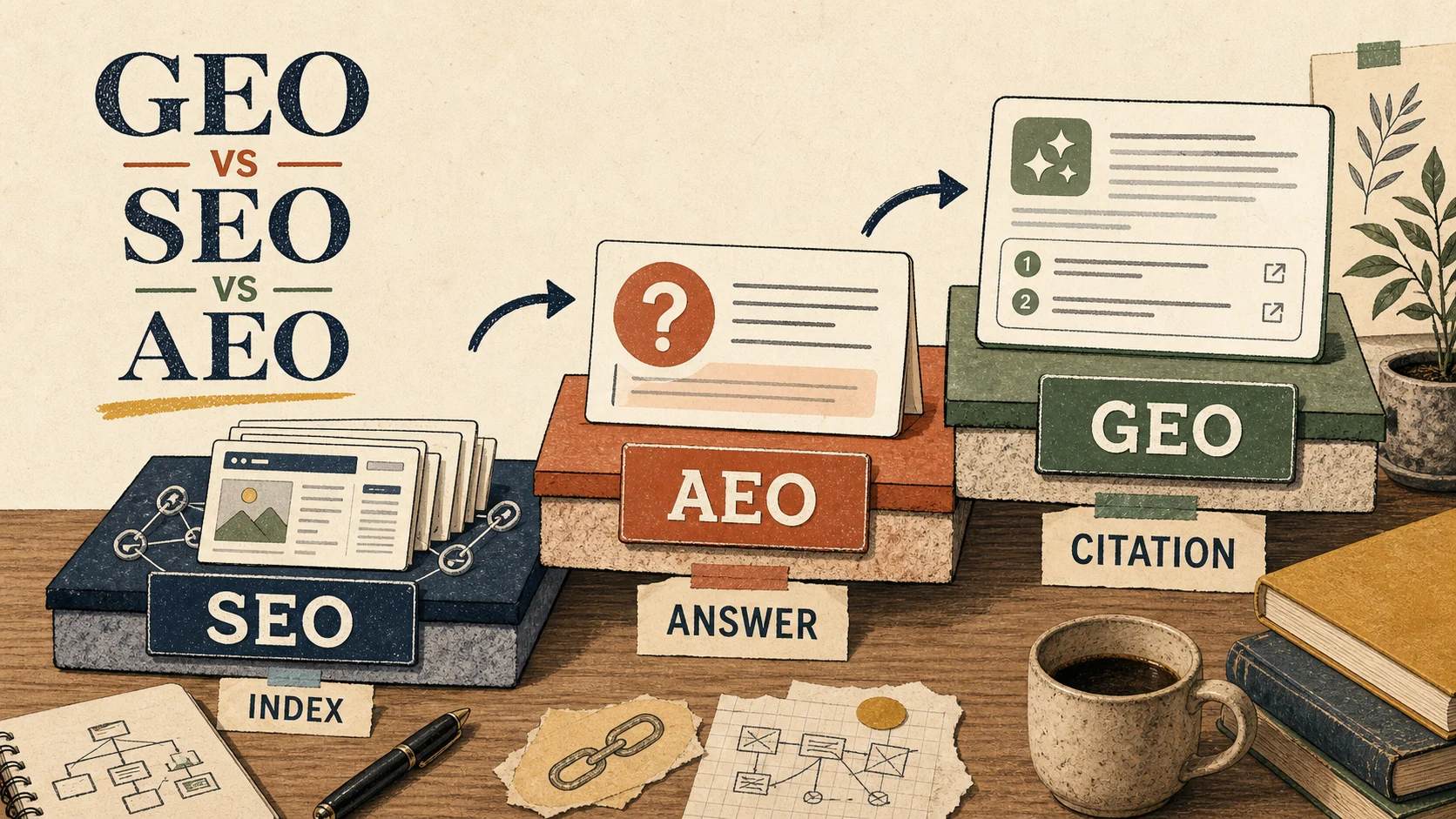
The internet has accumulated three similar acronyms for a simple shift: people still search for pages, but they increasingly also ask systems to summarize, compare, and recommend.
There is no single official industry taxonomy that cleanly separates the three terms. The table below is a practical operating model, not a promise that every platform uses the acronyms in exactly the same way.
| Layer | Primary outcome | What to improve | Typical measurement |
|---|---|---|---|
| SEO | A page is found and ranked in traditional search. | Crawlability, indexation, intent match, content quality, links, performance, and internal structure. | Impressions, clicks, rankings, indexed pages, organic conversions. |
| AEO | A system can extract a direct answer to a question. | Definitions, concise answers, headings, lists, tables, FAQs, entity clarity, and structured data where appropriate. | Featured snippets, answer visibility, question coverage, assisted conversions. |
| GEO | A brand or source appears accurately and prominently in a generative answer. | Evidence, original data, named authors, sources, entity consistency, citations, and content that is easy to quote without losing meaning. | Citation rate, mention share, answer accuracy, referral traffic, branded demand. |
The outcome changes by surface: a ranked page, an extracted answer, or a cited source inside a generated response.
Section comparison screenshotGoogle defines SEO as helping search engines understand your content and helping users find your site and decide whether to visit it. That is still the foundation for every other visibility layer. [1]
In practice, SEO means a search engine can access the page, understand its topic, connect it to the right query intent, and evaluate it as a useful result. That includes technical rendering, indexation, page experience, content quality, internal linking, structured data where relevant, and credible external signals.
If a page is blocked, thin, confusing, or impossible to interpret, adding a few FAQ headings will not make it an effective AEO or GEO asset. AI systems need discoverable source material before they can extract or cite it.
Answer the question early
Open a section with a bounded, plain-language answer before expanding into nuance. This helps both hurried readers and systems looking for a direct response.
Use question-shaped headings
Headings such as What is AEO?, How does it work?, and Does it replace SEO? align the page with conversational search intent.
Structure steps and comparisons
Numbered steps, short definitions, tables, examples, and checklists make the meaning of a page easier to retrieve without flattening the whole article into fragments.
Support important claims
An answer is more useful when it names the source, date, scope, assumptions, and limits. Do not turn certainty into a marketing claim just to sound quotable.
GEO is the least standardized of the three labels. In current practice, it usually describes work aimed at visibility inside generative answers: being retrieved, cited, mentioned, or represented correctly by systems such as Google AI features, ChatGPT, Perplexity, Gemini, and Claude.
That changes the unit of success. Traditional SEO often asks, 'What position does this URL have?' GEO also asks, 'When a user asks this category question, which sources does the system use, what does it say about our brand, and is the citation accurate?'
Useful GEO work is therefore not only prompt testing. It includes building a coherent entity, publishing evidence others can reference, earning relevant mentions, maintaining consistent business information, and writing pages whose claims remain meaningful when quoted out of context.
You do not need three separate articles for every topic. A strong page can perform three jobs when it has a clear hierarchy.
SEO job: make the page technically accessible
Use crawlable HTML, a useful title and description, logical headings, canonical URLs, internal links, good performance, and valid indexation.
AEO job: state the answer clearly
Place a concise definition or direct answer near the relevant heading, then expand with examples, caveats, steps, and FAQ content.
GEO job: make the claim defensible
Add authorship, dates, first-hand experience, original data, relevant sources, named entities, and context that survives quotation.
Measurement job: connect visibility to outcomes
Track rankings and clicks, but also citations, mentions, branded searches, referral sessions, qualified leads, and whether the answer describes you accurately.
important nuance
Google's documentation for AI features says the best practices for SEO remain relevant for AI Overviews and AI Mode. It also says there are no additional requirements to appear in these AI features beyond meeting Search policies and being indexed. [2]
That does not make answer visibility unimportant. It means the sensible approach is additive: fix the crawlability and content foundation first, then make the page easier to understand, extract, cite, and verify. Treat GEO as a visibility and authority layer, not as a secret replacement for technical SEO.
| Layer | Track | Do not overclaim |
|---|---|---|
| SEO | Search Console impressions/clicks, rankings, index coverage, organic conversions. | A ranking improvement does not automatically mean business growth. |
| AEO | Featured answer presence, question coverage, click-through and assisted conversions. | A structured FAQ does not guarantee a featured answer. |
| GEO | Citation and mention monitoring across relevant prompts, referral traffic, branded demand, and answer accuracy. | AI responses vary by user, location, model, freshness, and retrieval path; one prompt screenshot is not a stable ranking report. |
SEO focuses broadly on being discovered and ranked in search. AEO focuses on structuring content so a system can extract and present a direct answer, such as a featured snippet, voice response, or question-led result.
GEO usually means Generative Engine Optimization: improving the chance that a brand or source is retrieved, cited, mentioned, or represented accurately in generative AI answers. The term is still used inconsistently.
No. Google says SEO best practices remain relevant for AI features in Search. GEO and AEO should be treated as additional visibility layers built on crawlable, useful, trustworthy content.
No. Structured data can help systems understand a page, but it does not guarantee rankings, featured answers, or AI citations. Content quality, accessibility, evidence, relevance, and authority still matter.
There is no guaranteed timeline. Generative answers vary by query, model, location, freshness, and retrieval. Measure trends over time rather than treating one AI response as a ranking position.
Related Articles
AI Assistant Development Cost in 2026: RAG Chatbots, CRM Integrations, Guardrails, and Support
A practical buyer guide to AI assistant development cost in 2026: prototypes, RAG chatbots, knowledge-base assistants, CRM and website integrations, guardrails, evaluations, monitoring, and support.
AI-assisted attacks and prompt injection in 2026: the new attack surface for AI products
AI-assisted attacks and prompt injection in 2026: the new attack surface for AI products. A practical PAS7 Studio security guide with threat model, controls, rollout checklist, pitfalls, and sources.
AI for landing page development: where it speeds up launches and where it hurts conversion
A practical research piece on using AI for landing page development: v0, Webflow AI, Builder.io, Framer-like builders, UX generation, copy, SEO, personalization, A/B testing, template risk, accessibility, security and technical debt.
AI SEO / GEO in 2026: Your Next Customers Aren’t Humans — They’re Agents
Search is shifting from clicks to answers. Bots and AI agents crawl, cite, recommend, and increasingly buy. Learn what AI SEO / GEO means, why classic SEO is no longer enough, and how PAS7 Studio helps brands win visibility in the agentic web.
Professional development for your business
We create modern web solutions and bots for businesses. Learn how we can help you achieve your goals.