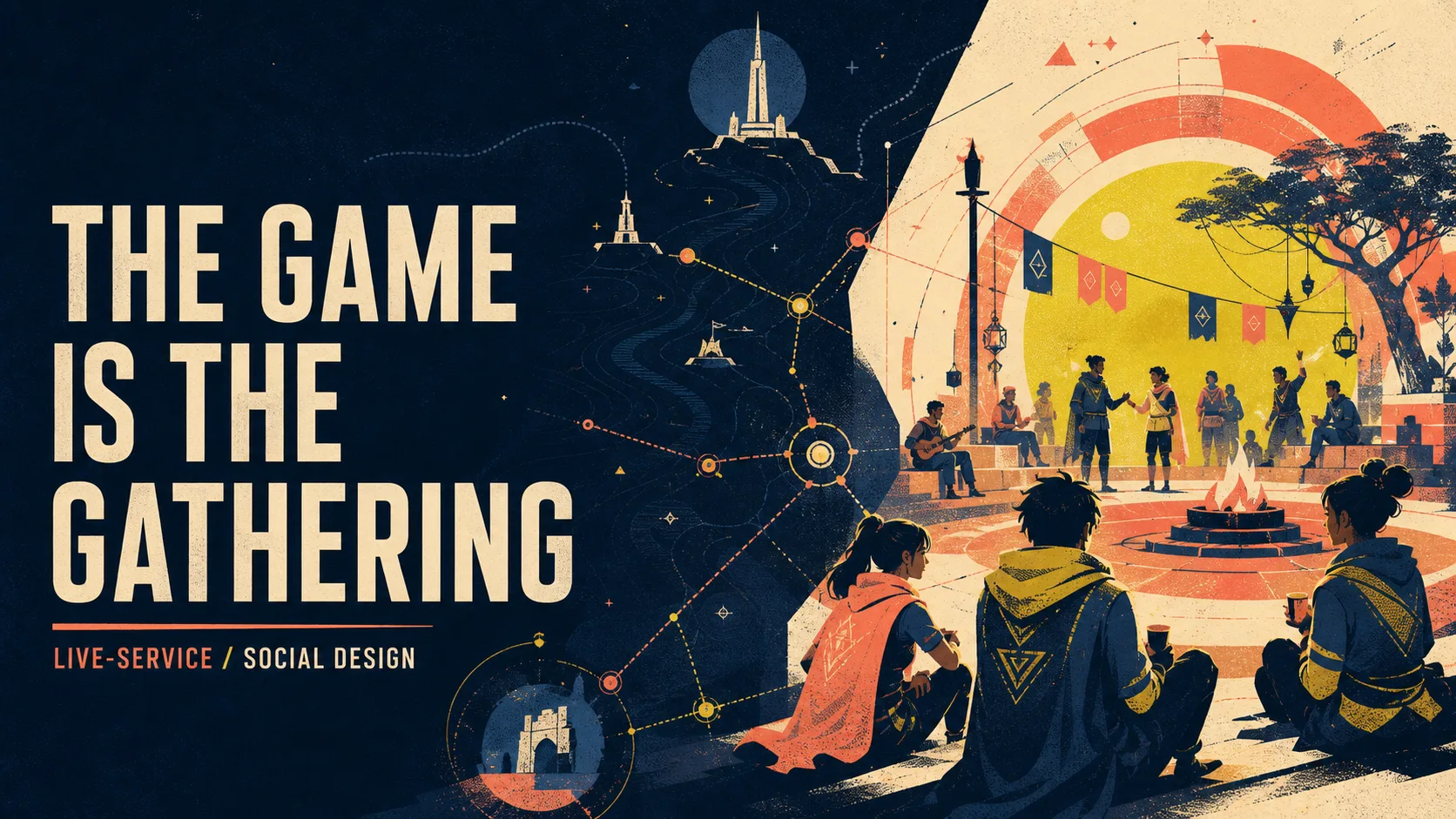
The Game Is the Gathering: Why Social Design Is Becoming Core Game Design
Live-service games are moving beyond content calendars. This analysis looks at social design, co-op, asynchronous play, cross-play friction, and the systems that turn a game into a place players return to together.
The current shift in live-service design is from shipping more isolated content to designing more reasons for players to coordinate, react, and return together. Unity’s 2026 report describes smaller, flexible social experiences as a growing direction, while its 2025 survey found 64% of respondents working on networked multiplayer or couch co-op. [1][2]
The valuable unit is no longer only the session
A content update can give a player something new to do. Social design gives them someone to do it with, a story to bring back, or a reason to care about what happens next.
Three patterns studios can use without building an MMO
The opportunity is not to copy the biggest live games. It is to choose one social behavior your product can support well.
Shared progress
Let a group contribute to a visible project: a base, collection, map, seasonal goal, or community unlock. The contribution should remain meaningful even when players have different schedules.
Asymmetric roles
Give players different information, abilities, or jobs. Asymmetry turns coordination into play instead of making every participant repeat the same task. It also gives friend groups a reason to talk.
Persistent traces
Leave behind routes, replays, annotations, builds, challenges, or recommendations. A player should be able to feel that another person was here without needing a live conversation.
Where the social promise breaks
Social systems magnify both delight and friction. They need product thinking, not just a multiplayer SDK.
Cross-play without cross-device parity: if one platform has worse input, performance, or onboarding, the larger pool can feel like a penalty. Unity’s 2026 report explicitly names consistent experiences across devices as a major obstacle. [1]
Retention metrics replacing the player relationship: daily streaks and notifications can increase return visits while making the game feel like an obligation. Measure whether players return with intention, not only whether they return.
Moderation treated as a launch add-on: the moment a product depends on player interaction, reporting, identity, privacy, and escalation become core flows.
A service model forced onto a finished game: continuous updates cannot repair a weak reason to play together. The social loop has to exist in the product’s premise.
Summary
A community is not a growth hack. It is another system your team must design, operate, and protect.
Should your next feature be social?
Before adding guilds, chat, or a seasonal event, test the underlying behavior.
Name the human moment
Can you describe the moment in plain language: “I want to show my friend what I found” or “we need different roles to solve this”?
Make participation flexible
Can a player contribute in ten minutes, miss a day, and return without feeling punished or lost?
Design the failure state
What happens when a teammate disconnects, a group disagrees, or a player wants to leave?
Plan the operating layer
Who owns moderation, event cadence, telemetry, support, and rollback after launch?
Sources and further reading
Build the reason people return together
Social design is not a layer you bolt onto a finished game. It is the design of a reason: a reason to coordinate, leave something behind, tell a story, or come back with the same people next week. That does not make every game a live service, and it does not make every social feature good. Before asking how to increase retention, ask what kind of relationship the game is trying to create — and whether the mechanics support it. The durable live-service advantage is therefore not infinite novelty. It is shared memory: the small moments that only happened because another player was there.
Related Articles
How to Add Mau Saver to a Telegram Group and Save Media in Chat
A practical guide to adding Mau Saver to a Telegram group and downloading videos, audio, and posts directly in the chat.

How to Advertise to an International Telegram Media Audience
A practical guide for advertisers: reach an international Telegram audience through Mau Saver Bot, group placements, pinned posts, and native media integrations.
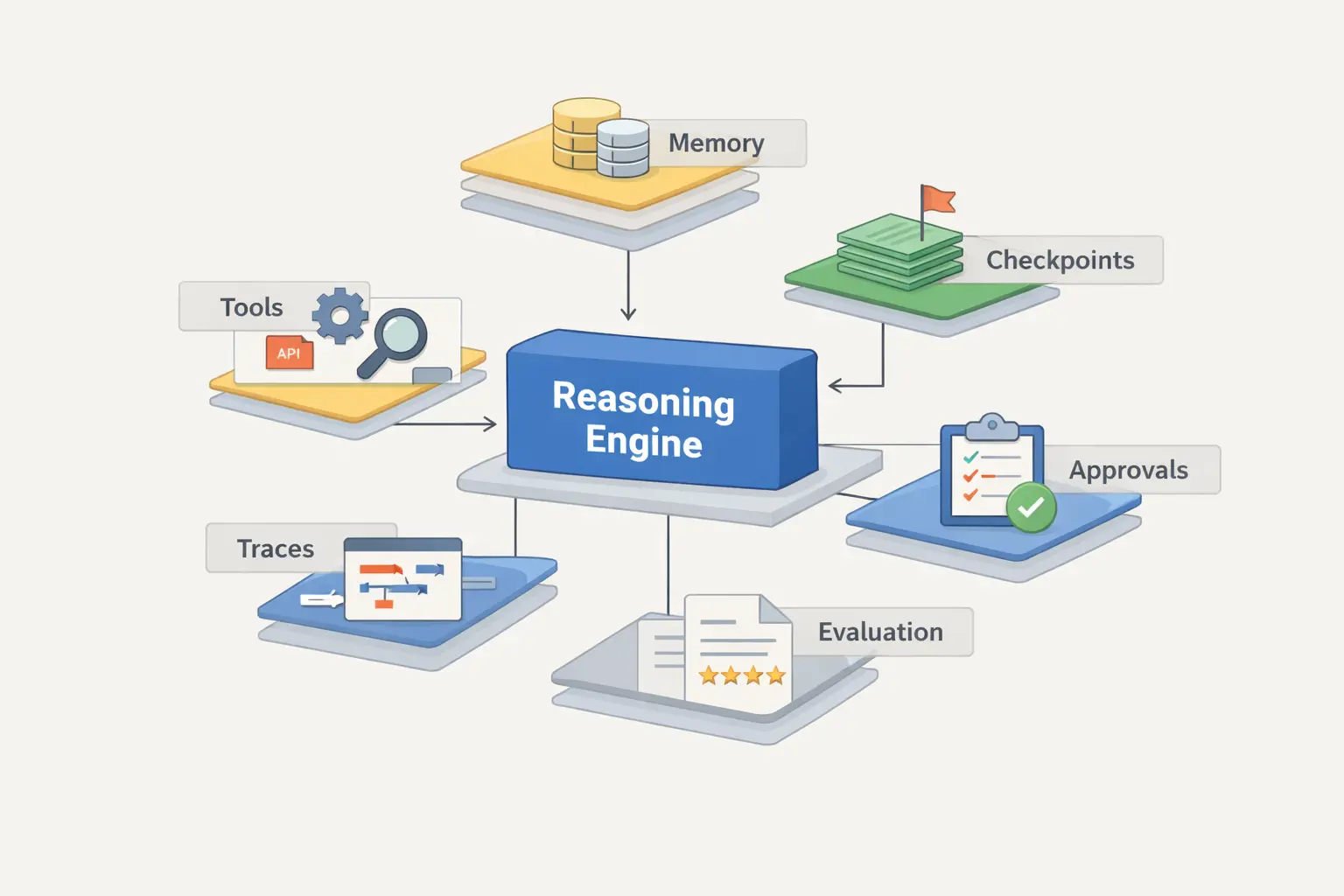
AI Assistant Development Cost in 2026: RAG Chatbots, CRM Integrations, Guardrails, and Support
A practical buyer guide to AI assistant development cost in 2026: prototypes, RAG chatbots, knowledge-base assistants, CRM and website integrations, guardrails, evaluations, monitoring, and support.
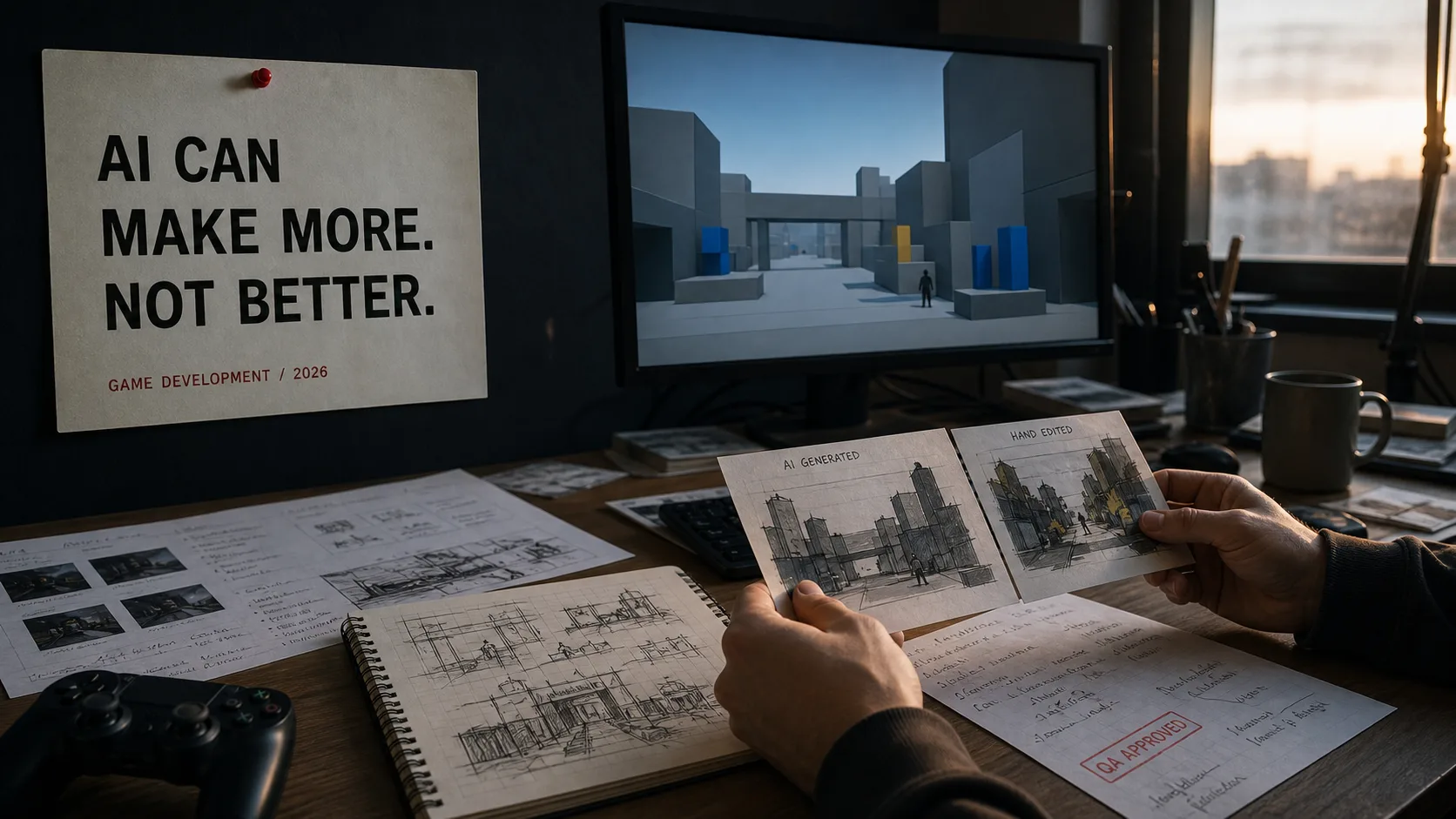
AI Can Make More. Not Better: What Game Development Research Actually Says
Generative AI is entering game production, but the evidence is more nuanced than the hype. We examine developer adoption, player reception, quality risks, and a practical production model for using AI without outsourcing taste.
Social design is more than adding a friends list
A friends list is infrastructure. Social design is the set of choices that makes being with other people meaningful. It answers four practical questions: what do players do together, how do they help each other, what can they remember, and how easily can they return after a week away?
Co-op is the obvious example, but it is not the only one. Asynchronous ghosts, shared collections, player-made challenges, spectator moments, guild projects, and lightweight rituals can all create social presence without requiring everyone to be online at the same time. The useful distinction is between communication and coordination: a voice channel lets people talk; a shared objective gives that talk a shape.
This is why the best social features often look modest in a feature list. A ping that says “your friend left a route here” can be more durable than another reward tier, because it creates a small piece of shared history.
Design cue
Start with the social action you want to happen, then build the minimum mechanic that makes it easy, legible, and worth repeating.