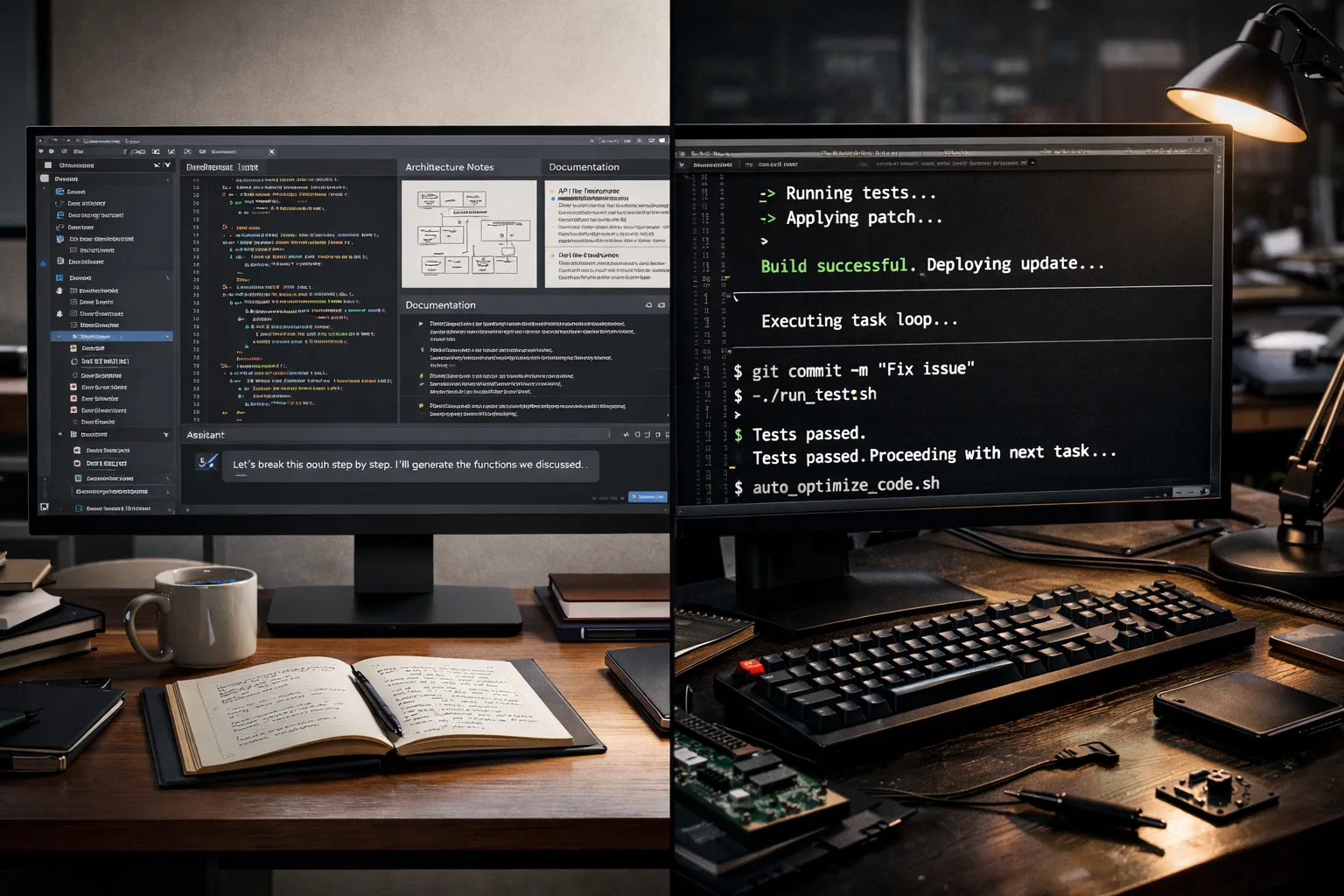
Claude or Codex for vibe coding in 2026: a practical comparison without hype
A practical comparison of Claude Sonnet 4.6 vs GPT-5.3-Codex for vibe coding in 2026: where each model is stronger, what fresh benchmarks actually show, how pricing changes the decision, and which workflow each model fits best.
Short version: the leader changes depending on the vibe coding workflow
As of February 27, 2026, the practical picture looks like this.
If you need a terminal-first agent that executes for a long time and you actively steer it in the loop, GPT-5.3-Codex currently looks very strong. OpenAI positions it as its strongest agentic coding model and claims new highs on SWE-Bench Pro and Terminal-Bench 2.0. [1][2][3]
What we mean by vibe coding in a real engineering team
In this article, vibe coding means a fast loop of idea -> code -> run -> feedback, often without heavy upfront design. The model needs to hold context well, edit existing code reliably, and keep the pace intact.
That is why we do not look at one benchmark score only. More important signals are how many iterations it takes to reach an acceptable result, how many manual fixes are needed after the model, and what one accepted change actually costs.
Exact technical data for Claude Sonnet 4.6 and GPT-5.3-Codex
Below is not a summary but a set of concrete numbers from official model pages and public benchmark announcements as of February 27, 2026.
| Model | Release | Context window | Max output | Input | Cached input | Output | Public benchmark signal |
|---|---|---|---|---|---|---|---|
| Claude Sonnet 4.6 | 2026-02-17 | 1M tokens beta in API | Not publicly specified | $3 / 1M | Not publicly specified | $15 / 1M | 80.2% SWE-bench Verified with prompt modification, 70% user preference vs Sonnet 4.5, 59% vs Opus 4.5 [4][5] |
| GPT-5.3-Codex | 2026-02-05 | 400k | 128k | $1.75 / 1M | $0.175 / 1M | $14 / 1M | 56.8% SWE-Bench Pro (Public), 77.3% Terminal-Bench 2.0, 64.7% OSWorld-Verified, and +25% speed vs GPT-5.2-Codex [1][2][3] |
For Claude Sonnet 4.6, Anthropic publicly gives a 1M context figure and pricing, but does not expose a separate max output or cached input line as explicitly as OpenAI does for GPT-5.3-Codex. That is also part of the real comparison: OpenAI currently ships a more detailed technical model card. [2][5]
The critical nuance is that Anthropic and OpenAI emphasize different benchmark surfaces. Sonnet 4.6 is publicly framed through SWE-bench Verified and human preference, while GPT-5.3-Codex is framed through terminal-agent execution and SWE-Bench Pro. That is not the same measurement axis, so the decision should be made by workflow, not by one row in a chart.
What public benchmarks show in practice
We keep Terminal-Bench, SWE-ReBench, and Aider in this article because they measure three different things: agent execution in the terminal, repo-level software engineering on decontaminated tasks, and code editing discipline without human help. Together this is much closer to real vibe coding than a single vendor benchmark.
Terminal-Bench 2.0
This benchmark checks whether an agent can actually complete a terminal workflow in a sandbox: receive a task, operate in shell, run commands, and finish with an automatic test verification. This is exactly the kind of setup where the difference between writes code well and gets the task done becomes visible. [6][9]
| Agent + model | Accuracy | What it means in practice |
|---|---|---|
| Droid + GPT-5.3-Codex | 77.3% ± 2.2 | Strongest public result in a terminal-first loop at the time of review |
| Simple Codex + GPT-5.3-Codex | 75.1% ± 2.4 | Strong result even in a more productized Codex setup |
| CodeBrain-1 + GPT-5.3-Codex | 70.3% ± 2.6 | Confirms the strength is not tied to one single agent shell |
| Terminus-KIRA + Claude Opus 4.6 | 74.7% ± 2.6 | Strongest Anthropic-side result in this public slice |
| Judy + Claude Opus 4.6 | 71.9% ± 2.7 | Claude is strong here too, but still below the top Codex rows |
| Droid + Claude Opus 4.6 | 69.9% ± 2.5 | Good execution score, but below the top Codex entry |
| Terminus 2 + GPT-5.3-Codex | 64.7% ± 2.7 | Even a benchmark-owned baseline agent with Codex stays strong |
Important nuance: the live leaderboard currently does not contain a Claude Sonnet 4.6 row. So the honest comparison is this: GPT-5.3-Codex already has strong public results across several agent setups, while the Anthropic-side terminal benchmark evidence currently shows Claude Opus 4.6 rather than Sonnet 4.6. For terminal-heavy work, that is still a strong point in Codex's favor, just not a fabricated Sonnet 4.6 vs Codex 5.3 one-to-one. [6]
SWE-ReBench
This is one of the most useful engineering benchmarks right now because it does not just count problems solved. It also reports Pass@5, cost per problem, tokens per problem, and cached tokens. It also works with a current time-bounded task set and flags potentially contaminated evaluations, so it is better protected against the the model has already seen these tasks problem. [7]
| Model | Resolved rate | Pass@5 | Cost / problem | Tokens / problem | Cached tokens |
|---|---|---|---|---|---|
| Claude Code | 62.1% | 74.5% | $1.29 | 1,971,650 | 92.3% |
| gpt-5.2-2025-12-11-medium | 61.3% | 74.5% | $0.47 | 884,110 | 84.3% |
| Claude Sonnet 4.5 | 60.9% | 70.2% | $0.88 | 1,780,611 | 96.2% |
| Claude Opus 4.5 | 60.4% | 70.2% | $1.03 | 1,191,384 | 94.9% |
| gpt-5.1-codex-max | 58.3% | 72.3% | $0.59 | 1,282,375 | 76.0% |
The key point here is not to pretend this is already a latest-vs-latest comparison. On the public SWE-ReBench leaderboard at the time of this article, there are no stable rows yet for Claude Sonnet 4.6 and GPT-5.3-Codex specifically. So the correct conclusion is different: SWE-ReBench currently confirms that Anthropic's stack and newer OpenAI coding models are very close on repo-level tasks, but for an exact latest-vs-latest comparison we still need the live rows to appear. [7]
Why this matters for vibe coding: if Terminal-Bench is more about execution, then SWE-ReBench is better at showing how a model behaves on real repository tasks with a longer sequence of edits, checks, and retries. For teams that spend more time changing live code in large repos than running shell-heavy workflows, this signal is often more important.
Aider leaderboard
Aider has a different focus. It tests how well a model edits code without human help, whether it follows the required edit format, and how often it returns a valid patch. In the polyglot set, that means 225 Exercism tasks across C++, Go, Java, JavaScript, Python, and Rust. [8]
| What Aider measures | Why it matters in this article |
|---|---|
| Percent correct | How often the model actually completes the code-edit task |
| Correct edit format | How reliably the model returns a patch in the right format |
| Cost | What that editing discipline costs in practice |
| Edit format | Whether the model works better with diff, whole, or another format |
For this article, Aider is a supporting benchmark rather than a primary one, because its leaderboard does not yet contain a clean Claude Sonnet 4.6 vs GPT-5.3-Codex head-to-head at the time of review. But it is still useful as a reminder: for vibe coding, it is not enough that a model understands code. It also needs to return changes in a format your toolchain can apply reliably. [8]
Practical conclusion: if your workflow is built around shell, tests, and long execution loops, the best public signal right now favors GPT-5.3-Codex. If your workday looks more like long repository sessions, complex edits, architectural changes, and large context, the case for Claude is stronger, but specifically for Sonnet 4.6 some independent live rows are still catching up.
Recommended screenshot: the top part of the Terminal-Bench 2.0 leaderboard with Droid + GPT-5.3-Codex, Simple Codex + GPT-5.3-Codex, and the closest Claude entries. [6]
Recommended screenshot: a SWE-ReBench table slice with current top rows for Claude Code, Sonnet 4.5, and OpenAI coding models. [7]
Section independent-benchmarks screenshotPros and cons without marketing noise
This is not a universal ranking. It is a practical map of strengths and weaknesses for an engineering team.
Claude Sonnet 4.6 - pros
1M context in API beta gives a different level of freedom for large codebases, technical documentation, and long sessions without aggressive context compression. On Anthropic's own page, the model also shows a strong preference signal: 70% of users preferred it over Sonnet 4.5, and 59% preferred it over Opus 4.5. For daily pair coding, that is a serious argument. [4][5]
Claude Sonnet 4.6 - cons
The weakness of Sonnet 4.6 is not the marketing signal. It is the smaller amount of fresh independent terminal-first benchmark coverage specifically for this model. If your team builds around long agent execution in CLI, you currently do not get the same clean public proof that GPT-5.3-Codex already has. [6][8]
GPT-5.3-Codex - pros
Codex 5.3 is strongest where it matters operationally: public terminal-agent results, a dedicated model line for coding workflows, a 400k context window, and a clear OpenAI push around interactive steering in the Codex app and API. If your team works through execution loops, shell commands, patching, and iterative test-fix cycles, this is a very strong stack. [1][2][3][6]
GPT-5.3-Codex - cons
Despite strong benchmark signals, Codex 5.3 has a shorter context window than Sonnet 4.6, and in long knowledge-heavy sessions that starts to matter faster. On top of that, some of its strongest public numbers are closely tied to OpenAI-specific execution setups, so teams should still verify results with an internal eval outside that environment. [1][2][6]
What the decision looks like in a real workflow
After benchmark numbers, the choice usually collapses into three practical scenarios.
Choose GPT-5.3-Codex if your main mode is a terminal-first agent, long execution chains, test-fix loops, shell automation, and constant manual steering. That is where the model currently has the best public evidence. [1][2][6]
Choose Claude Sonnet 4.6 if your daily work is pair coding, large code context, architecture-heavy edits, and long stable sessions at a reasonable price. Sonnet 4.6 looks more natural in that mode. [4][5][7]
Choose a hybrid setup if your team already works in two modes: Claude for long-form reasoning, reading code, and broad refactors, and Codex for execution-heavy slices where the main goal is to move quickly through edit -> run -> fix -> verify.
A minimal internal benchmark on 20 real tasks
If you are choosing a model for a quarter or for a whole team, the best move is not to argue over Twitter threads or vendor demos, but to run both models on your own task set.
type ModelId = "claude-sonnet-4-6" | "gpt-5.3-codex";

type Task = {
  id: string;
  prompt: string;
  testCommand: string;
};

type Result = {
  model: ModelId;
  taskId: string;
  passed: boolean;
  elapsedMs: number;
  inputTokens: number;
  outputTokens: number;
  manualFixes: number;
};

async function runTask(model: ModelId, task: Task): Promise<Result> {
  const t0 = Date.now();

  // 1) send prompt + repo context to model
  // 2) apply patch in sandbox branch
  // 3) run testCommand
  // 4) collect token usage from provider response

  return {
    model,
    taskId: task.id,
    passed: true,
    elapsedMs: Date.now() - t0,
    inputTokens: 12000,
    outputTokens: 1800,
    manualFixes: 1,
  };
}

function score(results: Result[]) {
  const n = results.length;
  const passRate = results.filter((r) => r.passed).length / n;
  const avgMs = results.reduce((s, r) => s + r.elapsedMs, 0) / n;
  const avgFixes = results.reduce((s, r) => s + r.manualFixes, 0) / n;

  return { passRate, avgMs, avgFixes };
}
The two metrics worth putting into a final decision table are pass rate and cost per accepted change. If Codex solves more tasks but costs more inside your actual loop, that needs to be visible in numbers. If Claude is cheaper but needs more manual fixes, that is also not a real win. It is hidden cost.
FAQ
Start with GPT-5.3-Codex in your real terminal workflow and compare it against a Sonnet-based setup on the same task set. The main metric is not your impression. It is the share of accepted changes without manual repair.
At the time of this article, fully symmetric independent head-to-head evidence is still limited. The right path is a fast internal eval on your own stack, plus public leaderboards as orientation.
In public API pricing, Sonnet 4.6 input is higher and output is close to GPT-5.3-Codex. But the final economics depend on caching, session length, and how many times tasks need to be rerun.
Based on public specifications, Sonnet 4.6 offers 1M context in API beta. If your workflow truly hits context limits, that can be a substantial advantage.
Yes. In 2026 that is often the most effective strategy: one model for daily pace, another for complex agentic tasks. The main thing is to define a clear policy for when each one is used.
Sources
Primary and specialist sources verified on February 27, 2026.
Related Articles

How to Add Mau Saver to a Telegram Group and Save Media in Chat
A practical guide to adding Mau Saver to a Telegram group and downloading videos, audio, and posts directly in the chat.

How to Advertise to an International Telegram Media Audience
A practical guide for advertisers: reach an international Telegram audience through Mau Saver Bot, group placements, pinned posts, and native media integrations.
AI Assistant Development Cost in 2026: RAG Chatbots, CRM Integrations, Guardrails, and Support
A practical buyer guide to AI assistant development cost in 2026: prototypes, RAG chatbots, knowledge-base assistants, CRM and website integrations, guardrails, evaluations, monitoring, and support.

AI Can Make More. Not Better: What Game Development Research Actually Says
Generative AI is entering game production, but the evidence is more nuanced than the hype. We examine developer adoption, player reception, quality risks, and a practical production model for using AI without outsourcing taste.