AI coding agents on a team: where speed ends and control begins
How to give an AI coding agent useful access to a repository, issue tracker, and environment without making CI, secrets, and production depend on a prompt.
An agent becomes useful once it can enter a real working environment
A coding agent without tools can explain a failure or write a code fragment. An agent with access to a repository, issue tracker, documentation, and test environment can complete much more of a task: find context, modify files, run checks, and prepare a pull request. That is what makes it valuable to an engineering team, and it also creates a new risk surface.
MCP gives applications a shared way to connect those tools. The protocol describes how a server exposes tools, while the current specification adds authorization flows and signals about tool behavior, including read-only and destructive operations. [1][2] The protocol does not decide whether an agent may press deploy. That decision remains with the team opening the access.
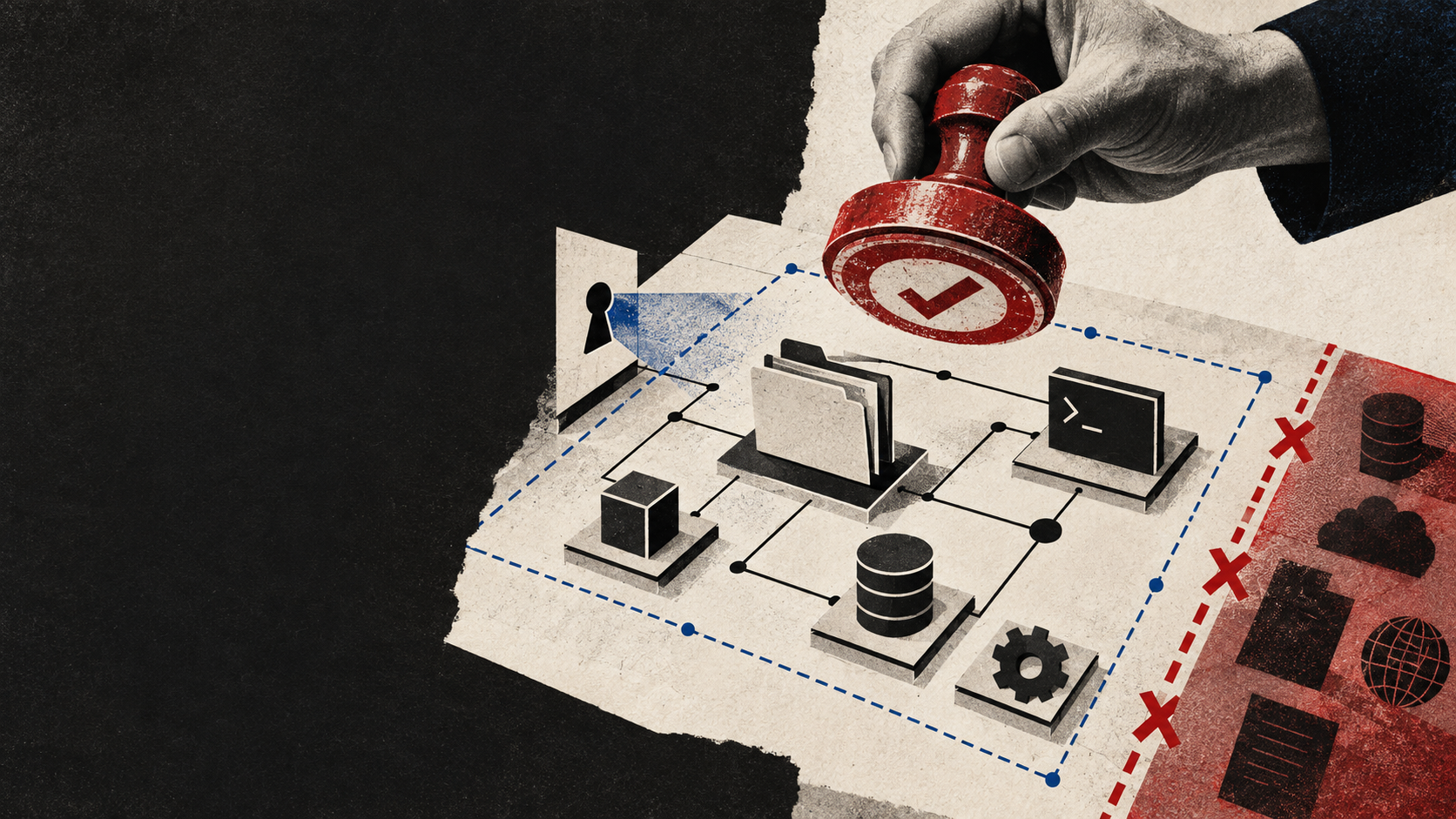
A strong starting point is therefore not ‘connect everything that already has an API’. It is one narrow task with a verifiable result. For example: the agent takes a Jira bug, works on an isolated branch, reads documentation and runs local tests, but has no production keys, merge permission, or access to payment data.
Four control layers to design before the first rollout
Reliability does not come from one large security prompt. It comes from several technical boundaries, each answering a different question.
| Layer | Question | Working rule |
|---|---|---|
| Task scope | What is the agent expected to do in this run? | Give it one concrete issue, acceptance criteria, and a step or time limit. Avoid an open-ended request to ‘improve the codebase’. |
| Tool permissions | Which systems and actions can it access? | Start read-only. Give write access through a separate tool and only for the required project, branch, or sandbox. |
| Approvals | Which actions are irreversible or have an external effect? | Merge, deploy, secret changes, data deletion, and sending messages should wait for explicit human confirmation. |
| Observability | Can the result be explained a week later? | Store a run ID, tools used, parameters, diff, test results, approval, and final status, without placing secrets in the trace. |
The best first workflow prepares a change instead of executing it in production
The lowest-risk, highest-learning workflow is one where the agent prepares a proposal for a human. It reads an issue, finds related modules, creates a branch, makes a small diff, runs a defined test set, and opens a pull request. The developer sees the changes in a familiar format, while CI remains an independent arbiter.
That is also better than ‘fix everything autonomously’ while a team still does not know the agent’s boundaries. Early runs reveal concrete rules: which tests it misses, where it chooses an overly broad refactor, which tool descriptions mislead the model, how much a normal run costs, and where a checkpoint is needed. The resulting rules can be tied to observed failures instead of assumptions.
A sandbox belongs in the design, not as an afterthought. The updated Agents SDK explicitly supports work with files, commands, and long-horizon tasks in controlled sandbox environments. [3] For code, that means an isolated checkout, short-lived credentials, separate test fixtures, and no network or production actions unless the task requires them.
MCP is an access interface, not proof of security
It is useful to think of MCP as an API contract for an agent. A good server describes narrow tools with predictable arguments, uses OAuth flows where user identity is required, and returns a result suitable for audit. The specification includes authorization-server discovery and OAuth-based authorization, but its presence does not replace the permission model in your system. [1]
A poor tool design looks like run_any_command, query_any_database, or deploy_everything. It moves all security into the model’s judgment. A better interface places limits in the name and schema: run_unit_tests, create_branch_from_issue, read_customer_by_id, or create_staging_deploy. The less interpretation required for a critical action, the easier it is to review, allow, or reject.
Treat outside text with particular care. Issues, comments, documentation, logs, and HTML can contain instructions that conflict with the assigned task. Tool permissions must not expand because of data the agent has just read. That boundary protects against both prompt injection and ordinary contextual mistakes.
Measure delivery quality, not generated lines of code
After a pilot, a team should be able to answer a few grounded questions. They show whether the agent reduces work instead of merely moving it into review.
What share of pull requests pass CI without manual fixes for basic errors?
How much reviewer time does an agent-generated diff take compared with a conventional change of the same size?
Which tools most often produce incomplete or unsafe results, and should their contract be narrowed?
Can a trace explain why the agent changed a particular file and which data it used?
How many runs stopped at approval, a step limit, or a policy check, and was that stop expected?
Automate preparation while keeping accountability visible
AI coding agents are useful when a team can describe the result clearly, provide a narrow tool set, and verify the work through code, tests, and review. In that mode they reduce context hunting and mechanical changes without hiding responsibility for quality inside a black box.
Once a workflow is stable, autonomy can expand one action class at a time: create a branch, then a draft pull request, then staging. Production merge or data changes should appear only after the team has accumulated enough traces, evaluations, and understandable rules for that specific scenario.
Sources
Related Articles
How to Add Mau Saver to a Telegram Group and Save Media in Chat
A practical guide to adding Mau Saver to a Telegram group and downloading videos, audio, and posts directly in the chat.

How to Advertise to an International Telegram Media Audience
A practical guide for advertisers: reach an international Telegram audience through Mau Saver Bot, group placements, pinned posts, and native media integrations.
AI Assistant Development Cost in 2026: RAG Chatbots, CRM Integrations, Guardrails, and Support
A practical buyer guide to AI assistant development cost in 2026: prototypes, RAG chatbots, knowledge-base assistants, CRM and website integrations, guardrails, evaluations, monitoring, and support.

AI Can Make More. Not Better: What Game Development Research Actually Says
Generative AI is entering game production, but the evidence is more nuanced than the hype. We examine developer adoption, player reception, quality risks, and a practical production model for using AI without outsourcing taste.