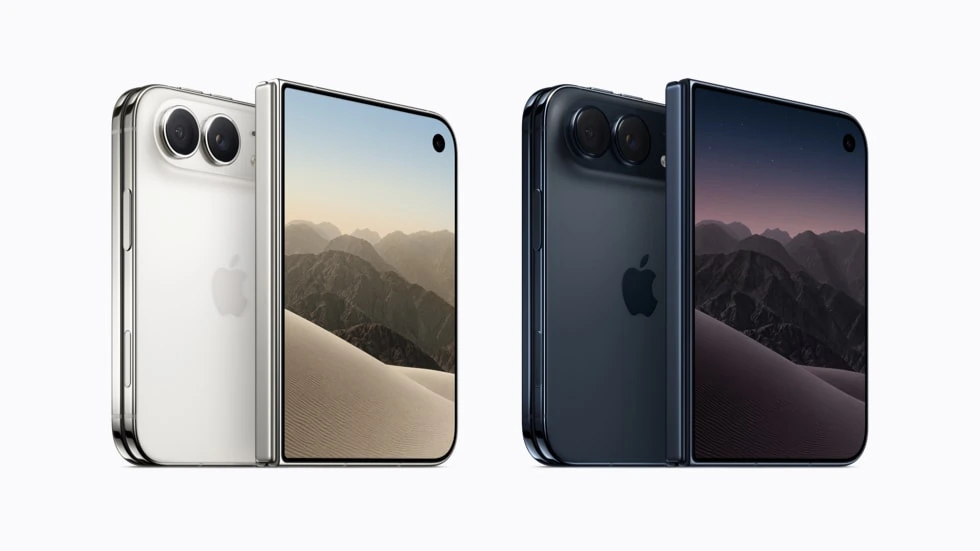
iPhone Duo launches October 23: the compromises behind Apple’s foldable
iPhone Duo arrives October 23. Compare its displays, cameras, folded size and regional limits with Galaxy Z Fold8 and Xiaomi 18 Fold before launch.
October 23 starts the first wave
Apple’s first foldable iPhone reaches its first launch markets on Friday, October 23, 2026, after pre-orders opened on October 16. Germany is among those markets; another wave follows on October 30. The starting price is $1,999 in the US and €2,299 including VAT in Germany. Those dates describe Apple’s rollout, rather than a delivery promise for every new order. [1][6]
Duo opens like a book into a 7.6-inch screen and closes around a 5.4-inch outer screen. For an Apple user, the attraction is having room for two apps while keeping familiar iPhone software. The trade-offs include a substantial folded body, Touch ID authentication and a camera system without a separate long telephoto lens. This briefing was checked on October 19; PAS7 has not handled or tested these devices. [1][2]
Duo, Fold8 and 18 Fold: compare the same class of phone
These are manufacturer specifications, not our measurements. Samsung’s column covers Galaxy Z Fold8; Fold8 Ultra is a different model with an 8-inch inner screen and a telephoto camera. Display diagonals are rounded marketing figures. Xiaomi’s column refers to the standard Chinese model. [2][4][5]
| Specification | iPhone Duo | Galaxy Z Fold8 | Xiaomi 18 Fold |
|---|---|---|---|
| Outer / inner display | 5.4 / 7.6 inches | 5.5 / 7.6 inches | 5.38 / 7.58 inches |
| Weight | 254 g | 201 g | 219 g |
| Thickness: open / closed | 5.2 / 11.3 mm | 4.5 / 9.7 mm | 5.02 / 10.68 mm |
| Processor | A20 Pro | Snapdragon 8 Elite Gen 5 for Galaxy | XRING O3 |
| Rear cameras | 48 MP main + 48 MP ultrawide | 50 MP main + 50 MP ultrawide | 200 MP main + 50 MP 3.5x periscope + 50 MP ultrawide |
| Separate telephoto lens | No; 2x optical-quality option from main camera | No | Yes; 3.5x optical zoom |
| Battery figure published here | 44 h outer / 31 h inner video playback; Apple claim | 4,800 mAh; typical capacity | 6,000 mAh; typical capacity |
The advantage is what you can do across the two screens
Split View puts two apps side by side, including two windows from an app such as Safari. Reading a specification sheet while keeping notes beside it is an understandable reason to unfold a phone. Apple also adapts content as Duo folds or rotates. The quality of that experience still depends on the individual app: Apple has opened Duo app submissions and published layout guidance for developers. A large panel alone cannot guarantee a well-adapted interface. [3][7]
The folding body also becomes a support for hands-free calls and photography. An outer-screen preview lets a person being photographed check the framing, and it lets the owner use the rear cameras for selfies. These uses exploit hardware that already has to exist for the foldable format. [1]
Apple’s matte nano-texture layer aims to reduce glare and make the crease less visible. That is a useful design priority for reading and indoor reflections. It does not establish that the fold has disappeared physically or that contrast, sharpness and scratch resistance are identical to a conventional glass-covered iPhone. Those qualities need inspection in different lighting and after extended use. [1]
5.2 mm open becomes 11.3 mm in your pocket
Apple’s headline thinness refers to the unfolded device. With both halves closed, Duo is thicker and heavier than both competitors in the table. Using the published nominal figures, the difference from Fold8 is 254 − 201 = 53 g, or 26.4% of Fold8’s weight. The folded thickness difference is 11.3 − 9.7 = 1.6 mm, or 16.5%. These are our calculations from manufacturer data; camera protrusions and measurement conventions have not been normalized. [2][4][5]
That changes the meaning of compact. A short body can take up less height in a pocket while adding weight and thickness. Anyone moving from a tall conventional phone should try the folded width, keyboard and grip rather than infer comfort from the 5.4-inch diagonal. Our comparison does not turn those dimensions into a claim that one phone feels better in every hand.
The engineering is more involved than joining two thin slabs. Apple describes a hinge with more than 100 components, structural ribs, a titanium support plate and display layers that slide against one another to relieve bending stress. Those details help explain the packaging challenge. They do not tell us how much each component contributes to the weight, or prove that a particular omission was required to make the phone thinner. [1]
Two rear cameras leave room for a different kind of photography
Duo has a 48 MP main camera and a 48 MP ultrawide. Apple’s 2x optical-quality option uses the main camera; it does not add a separate telephoto module. The ordinary Fold8 also has a dual-camera setup. Xiaomi is the one of these three with a dedicated 3.5x periscope, alongside its 200 MP main and 50 MP ultrawide. A distant stage or architectural detail is therefore a different comparison from an ultrawide group selfie. Megapixel counts alone cannot settle image quality. [2][4][5]
Touch ID in the side button is another visible choice. It offers the same authentication point with Duo open or closed, but a user accustomed to looking at an iPhone to unlock it will have to change that habit. The specifications list Touch ID, not Face ID. Describing this as a proven necessity of thinness would go beyond Apple’s published explanation. [1][2]
Battery, Pencil and regional software need separate checks
A 6,000 mAh battery sounds like an easy victory over 4,800 mAh, but capacity is only part of runtime. Display use, software, modem behavior and workload also matter. Apple publishes up to 44 hours of local video playback on the outer screen and 31 on the inner screen. These are Apple’s test claims; our table deliberately preserves the different units rather than invent a three-way battery ranking. Xiaomi also lists up to 67 W wired and 50 W wireless charging under compatible conditions. Peak watts do not establish the time to a full charge. [2][4][5]
Apple Pencil with USB-C support is promised for later in 2026. It should not be counted as an available launch-day advantage. Apple’s German announcement also says Siri AI and features that depend on it will initially be unavailable in the EU on iOS. Ukrainian is absent from the published Apple Intelligence language list. Ordinary Ukrainian interface support is a separate question from support for those AI features. [1][6]
The Xiaomi materials checked here describe the Chinese product and a starting price of CNY 10,999. They do not establish an official German or Ukrainian launch. An import comparison needs the exact software version, carrier compatibility, service arrangements and total local price. Converting the Chinese sticker price into euros would not make the offers equivalent. Similarly, Apple’s October 23 first wave should not be treated as a verified Ukrainian retail date. [1][8]
The tests worth watching after October 23
For a reader staying with Apple, the first useful test is a familiar pair of apps used across repeated folds: does each keep its place and provide enough room to work? For someone choosing across platforms, the next comparison should keep the same tasks, brightness and network conditions, with separate results for inner-screen use. Camera samples should include distant subjects as well as close ones.
Extended hinge and inner-screen wear, sustained performance, third-party layouts and actual regional feature availability remain open questions in this pre-launch analysis. Fold8 establishes a lighter reference point; Xiaomi establishes a dedicated-zoom alternative. Duo’s case rests on how useful the larger workspace becomes within iOS once customers can use it every day.
Sources and official product pages
Cover image: Apple Newsroom. Official product photography; PAS7 has not tested the device.